Frequently Asked Questions
Q: What are the 'cities of refuge' mentioned in Numbers 35:12?
A: The 'cities of refuge' (ערי מקלט) were six designated cities in Israel where someone who accidentally killed another person could flee for protection. According to Rashi and the Talmud (Makkot 9b), these cities provided safety from the 'avenger of blood' (usually a relative of the deceased) until a proper trial could determine if the killing was intentional or accidental.
Q: Why did the Torah establish cities of refuge?
A: The Torah established cities of refuge to ensure justice and prevent vigilante killings. As Rambam explains in Hilchot Rotzeach (Laws of Murder 8:4), this system balanced compassion for accidental killers with justice for intentional murderers. The verse emphasizes due process ('until he stands before the congregation for judgment'), teaching that no one should be punished without a fair trial.
Q: What lesson can we learn from the cities of refuge today?
A: The cities of refuge teach the importance of fair justice and protecting the innocent. The Midrash (Sifrei Bamidbar) notes that roads to these cities were always kept clear, showing society's obligation to make justice accessible. Today, this reminds us to create systems that protect people from wrongful harm while upholding proper legal procedures.
Q: Who was the 'avenger of blood' in this verse?
A: The 'avenger of blood' (גואל הדם) was typically a close relative tasked with seeking justice for a family member's death. However, as Rashi and the Talmud (Sanhedrin 45b) explain, the Torah restricts this role—the avenger could only act outside the cities of refuge, and only after proper trial confirmed intentional murder. This prevented cycles of revenge killings.
Q: How long did someone stay in a city of refuge?
A: According to the Talmud (Makkot 11a), an accidental killer remained in the city of refuge until the death of the Kohen Gadol (High Priest). Rambam (Hilchot Rotzeach 7:1) explains this was meant to encourage reflection, as the Kohen Gadol's role was to bring atonement and peace to Israel. This period also allowed emotions to cool in the victim's family.

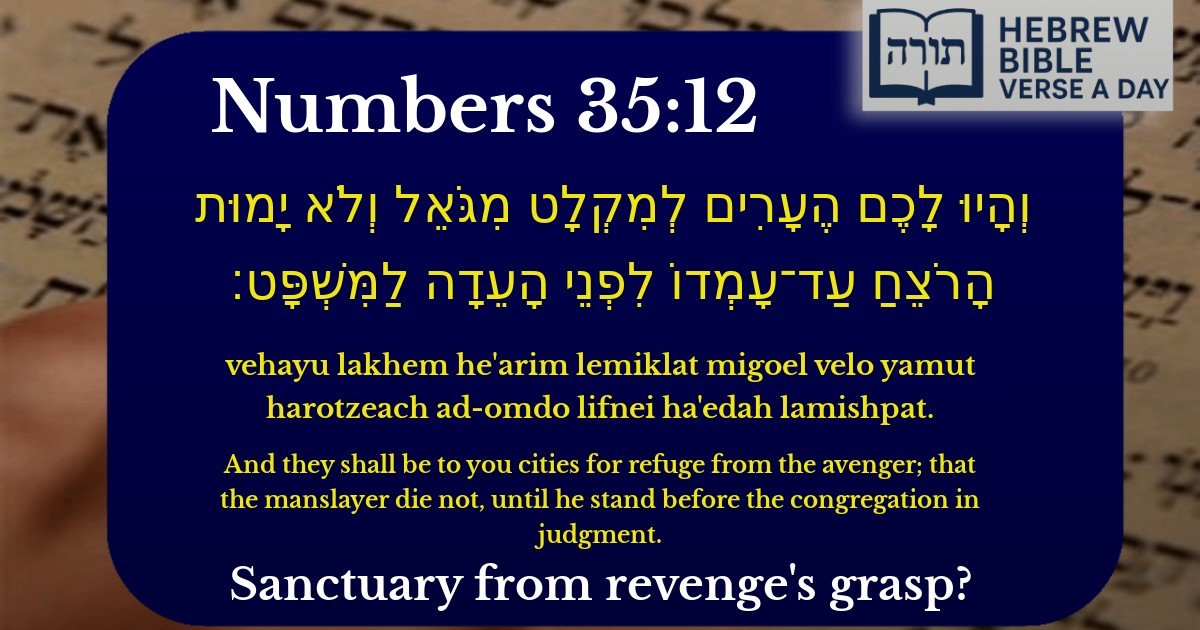

The Cities of Refuge (ערי מקלט)
The verse discusses the establishment of ערי מקלט (cities of refuge) for someone who kills unintentionally. These cities serve as a sanctuary from the גואל הדם (the avenger of blood), preventing the accidental killer from being slain before standing trial.
Rashi's Explanation
Rashi (on Bamidbar 35:12) explains that the גואל הדם is a close relative of the victim who may seek vengeance. The Torah mandates that the accidental killer must flee to one of these cities to avoid being killed prematurely. The phrase "וְלֹא יָמוּת הָרֹצֵחַ" ("that the manslayer die not") emphasizes that justice must be determined by the court, not by vigilante retribution.
Purpose of the Cities of Refuge
Midrashic Insight
The Midrash Tanchuma (Masei 8) compares the cities of refuge to the concept of תשובה (repentance), teaching that just as these cities provide physical protection, sincere repentance provides spiritual refuge from punishment.
Halachic Implications
The Mishnah (Makkos 2:6) details that the accidental killer must remain in the city of refuge until the death of the Kohen Gadol. The Talmud (Makkos 11b) explains that this serves as an additional atonement mechanism, linking the killer's fate to the spiritual leadership of the nation.