
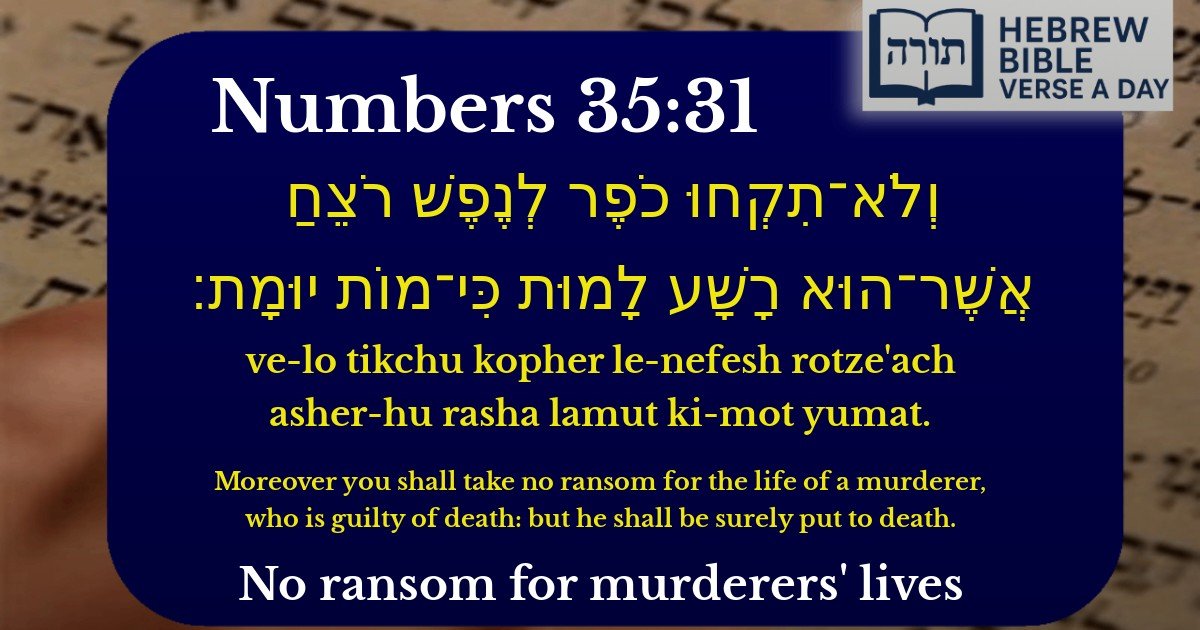

Numbers 35:31 - No ransom for murderers' lives

Numbers 35:31 - במדבר 35:31

Hebrew Text

וְלֹא־תִקְחוּ כֹפֶר לְנֶפֶשׁ רֹצֵחַ אֲשֶׁר־הוּא רָשָׁע לָמוּת כִּי־מוֹת יוּמָת׃

English Translation

Moreover you shall take no ransom for the life of a murderer, who is guilty of death: but he shall be surely put to death.

Transliteration

Ve-lo tikchu kopher le-nefesh rotze'ach asher-hu rasha lamut ki-mot yumat.

Hebrew Leining Text

וְלֹֽא־תִקְח֥וּ כֹ֙פֶר֙ לְנֶ֣פֶשׁ רֹצֵ֔חַ אֲשֶׁר־ה֥וּא רָשָׁ֖ע לָמ֑וּת כִּי־מ֖וֹת יוּמָֽת׃

🎵 Listen to leining

Parasha Commentary

Prohibition Against Accepting Ransom for a Murderer

The verse (Bamidbar 35:31) states unequivocally that one may not accept a ransom (kofer) for the life of a murderer who is guilty of death. This law emphasizes the severity of murder and the absolute requirement for justice in such cases.

Rashi's Explanation

Rashi comments that this verse teaches that even if the murderer offers all the money in the world, and even if the victim's family is willing to accept compensation, the court is forbidden to accept it. The Torah insists that the murderer must be put to death (ki-mos yumas), as there is no atonement for his crime other than his own life.

Rambam's Legal Perspective

In Hilchos Rotzeach U’Shemiras Nefesh (1:4), the Rambam codifies this law, stating that a murderer may not be pardoned or have his sentence commuted under any circumstances. He explains that accepting a ransom would undermine the deterrent effect of the death penalty and devalue human life, as it would imply that a life can be compensated monetarily.

Talmudic Discussion

The Gemara in Sanhedrin (45b) derives from this verse that the prohibition applies even if the murderer is a Torah scholar or a person of high stature. No exceptions are made, reinforcing the principle that justice must be impartial and absolute.

Moral and Theological Implications

  • Sanctity of Life: The Torah's insistence on capital punishment for murder underscores the infinite value of human life, which cannot be equated with material compensation.
  • Divine Justice: The Sages teach that failing to execute a murderer disrupts the moral order, as his unpunished crime "defiles the Land" (Bamidbar 35:33-34).
  • Deterrence: The severity of the punishment serves as a deterrent, ensuring societal respect for life and discouraging acts of violence.

Midrashic Insight

The Sifrei (Bamidbar 161) elaborates that this law reflects the principle of "middah k'neged middah" (measure for measure): just as the murderer showed no mercy in taking a life, the court must show no mercy in carrying out justice.

📚 Talmud Citations

This verse is quoted in the Talmud.

📖 Sanhedrin 52b
The verse is cited in a discussion about the prohibition of accepting ransom for a murderer, emphasizing that a murderer must be put to death and no monetary compensation can be accepted in lieu of execution.
📖 Makkot 5b
Referenced in the context of discussing the laws of murder and the inapplicability of ransom, reinforcing the principle that a murderer cannot escape capital punishment through payment.

Frequently Asked Questions

Q: What does Numbers 35:31 mean when it says not to take a ransom for a murderer?
A: The verse teaches that a murderer who has been rightfully convicted cannot escape punishment by paying money or offering compensation. According to Jewish law (based on the Torah and Talmud), intentional murder is such a severe crime that monetary payment cannot atone for it—justice requires the death penalty (when properly administered by a qualified Jewish court). Rashi explains that this law emphasizes the infinite value of human life, which cannot be replaced by material compensation.
Q: Why is the law in Numbers 35:31 important in Judaism?
A: This law underscores the Torah's strict stance against murder and the sanctity of human life. The Rambam (Mishneh Torah, Laws of Murder 1:4) explains that allowing ransom for murder would devalue life and lead to corruption in justice. The Talmud (Sanhedrin 45b) also discusses how this law ensures societal accountability—showing that certain crimes are beyond monetary repair and require absolute justice to maintain moral order.
Q: Does this verse mean capital punishment is required for murderers today?
A: While the Torah mandates the death penalty for intentional murder, Jewish law (as codified in the Talmud and later authorities) sets extremely high standards of evidence and procedure, making actual executions rare. The Mishnah (Makkot 1:10) states that a Sanhedrin (Jewish high court) that executed once in 70 years was called 'destructive.' Today, without a Sanhedrin or Temple, Jewish courts do not carry out capital punishment, but the verse still teaches the severity of murder in G-d's eyes.
Q: What lesson can we learn from Numbers 35:31 today?
A: This verse teaches that justice must be upheld without compromise for severe crimes like murder. The Midrash (Sifrei Bamidbar 161) connects this to the idea that human life is sacred and cannot be 'traded' for money. Practically, this reminds us to value every life, oppose corruption in legal systems, and ensure that true justice—not wealth or influence—determines outcomes for serious offenses.