Frequently Asked Questions
Q: What does Numbers 35:32 mean?
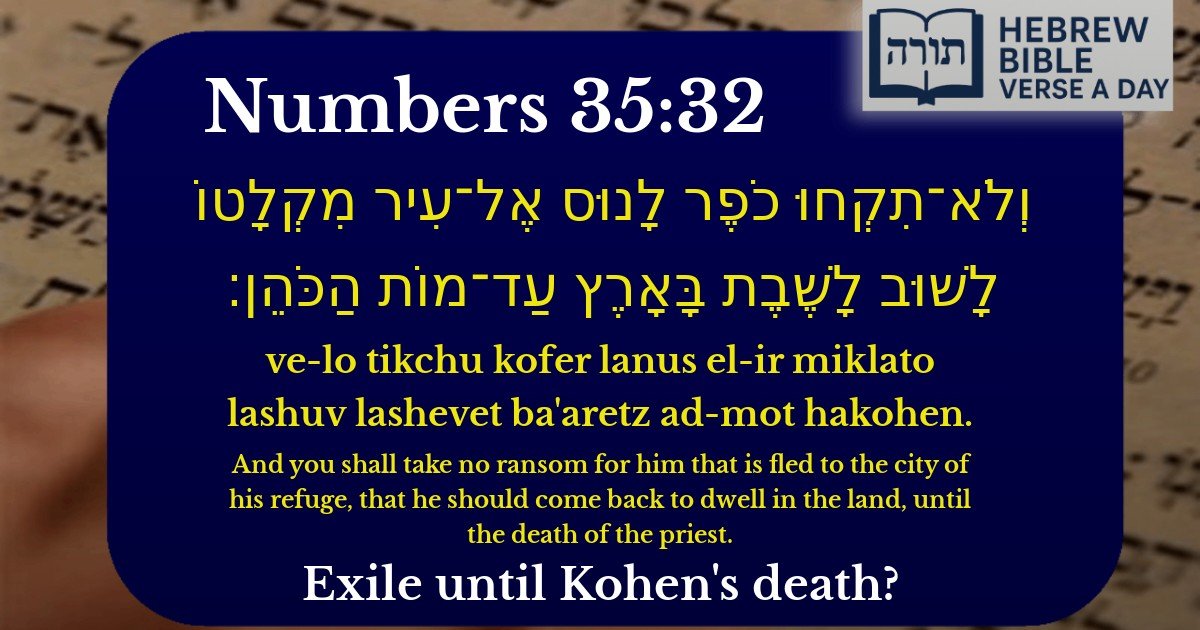
A: Numbers 35:32 teaches that someone who accidentally kills another person and flees to a 'city of refuge' (a protective city for unintentional killers) cannot pay money to leave early. They must stay there until the current High Priest (Kohen Gadol) passes away. This law emphasizes that life is sacred and cannot be compensated with money (Rashi, Talmud Makkot 11b).
Q: Why can't the accidental killer pay to leave the city of refuge?
A: The Torah forbids taking ransom money because human life is invaluable—no amount of money can undo a loss of life, even accidentally (Rambam, Hilchot Rotzeach 7:10). Staying in the city of refuge serves as both protection and atonement, teaching the seriousness of causing death, even unintentionally.
Q: Why does the killer's release depend on the High Priest's death?
A: The High Priest represents atonement and spiritual leadership for the Jewish people. His passing symbolizes a new era of atonement, allowing the unintentional killer to return home (Talmud Makkot 11b). This also connects the community to the tragedy, as they share in the loss of their leader.
Q: Do cities of refuge still apply today?
A: Since we currently lack a Temple and a functioning Sanhedrin (Jewish high court), the laws of cities of refuge are not practiced today. However, the moral lesson remains: we must take extreme care to avoid harming others, even unintentionally (Rambam, Hilchot Rotzeach 8:4).
Q: What can we learn from this verse today?
A: This verse teaches that actions have consequences, even accidental ones. It also shows that justice requires time and reflection—money cannot replace accountability. Additionally, it highlights the Torah's deep value for human life and the need for communal responsibility (Midrash Tanchuma, Massei 10).


Context of the Verse
This verse (Bamidbar 35:32) appears in the context of the laws concerning the cities of refuge (ערי מקלט), where an unintentional murderer (רוצח בשגגה) is required to flee for protection from the avenger of blood (גואל הדם). The Torah prohibits accepting a ransom (כופר) to allow the accidental killer to return home before the death of the Kohen Gadol (High Priest).
Explanation of the Prohibition
Rashi explains that the Torah forbids taking monetary compensation in lieu of the exile because "the blood of the slain cannot be atoned for by money." The accidental killer must remain in the city of refuge as a form of atonement, and no financial payment can substitute for this Divine decree. Rambam (Hilchos Rotzeach 5:12) similarly emphasizes that this law underscores the sanctity of human life—even unintentional taking of life requires a serious consequence.
Significance of the Kohen Gadol's Death
The Talmud (Makkos 11a) discusses why the accidental killer's exile ends specifically with the death of the Kohen Gadol. One opinion suggests that the Kohen Gadol bears some responsibility for not praying sufficiently for his generation, as his spiritual leadership should have prevented such tragedies. Alternatively, the death of the Kohen Gadol serves as a form of atonement for the nation, allowing the exiled individual to return home.
Moral and Halachic Lessons