
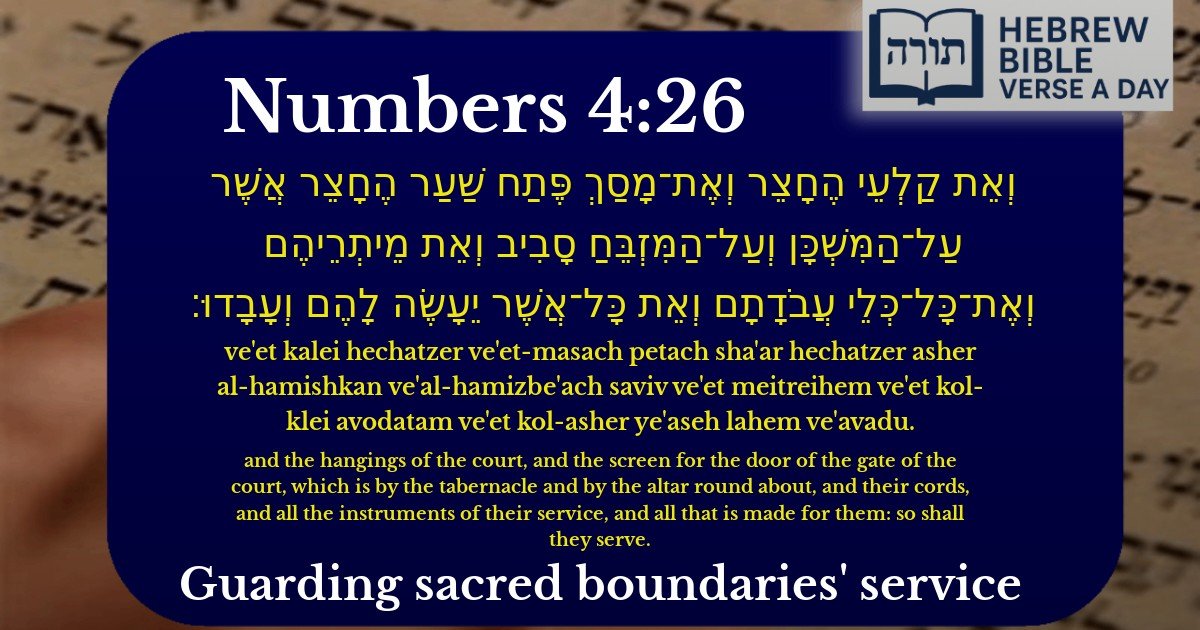

Numbers 4:26 - Guarding sacred boundaries' service

Numbers 4:26 - במדבר 4:26

Hebrew Text

וְאֵת קַלְעֵי הֶחָצֵר וְאֶת־מָסַךְ פֶּתַח שַׁעַר הֶחָצֵר אֲשֶׁר עַל־הַמִּשְׁכָּן וְעַל־הַמִּזְבֵּחַ סָבִיב וְאֵת מֵיתְרֵיהֶם וְאֶת־כָּל־כְּלֵי עֲבֹדָתָם וְאֵת כָּל־אֲשֶׁר יֵעָשֶׂה לָהֶם וְעָבָדוּ׃

English Translation

and the hangings of the court, and the screen for the door of the gate of the court, which is by the tabernacle and by the altar round about, and their cords, and all the instruments of their service, and all that is made for them: so shall they serve.

Transliteration

Ve'et kalei hechatzer ve'et-masach petach sha'ar hechatzer asher al-hamishkan ve'al-hamizbe'ach saviv ve'et meitreihem ve'et kol-klei avodatam ve'et kol-asher ye'aseh lahem ve'avadu.

Hebrew Leining Text

וְאֵת֩ קַלְעֵ֨י הֶֽחָצֵ֜ר וְאֶת־מָסַ֣ךְ ׀ פֶּ֣תַח ׀ שַׁ֣עַר הֶחָצֵ֗ר אֲשֶׁ֨ר עַל־הַמִּשְׁכָּ֤ן וְעַל־הַמִּזְבֵּ֙חַ֙ סָבִ֔יב וְאֵת֙ מֵֽיתְרֵיהֶ֔ם וְאֶֽת־כׇּל־כְּלֵ֖י עֲבֹדָתָ֑ם וְאֵ֨ת כׇּל־אֲשֶׁ֧ר יֵעָשֶׂ֛ה לָהֶ֖ם וְעָבָֽדוּ׃

🎵 Listen to leining

Parasha Commentary

Overview of the Verse

This verse (Exodus 35:18) describes the components of the Mishkan (Tabernacle) courtyard, including its hangings, screens, cords, and service vessels. These elements were essential for the functioning of the Mishkan and the service of the Kohanim (priests). The verse emphasizes the completeness of the items required for the sacred work, highlighting the meticulous attention to detail in the Divine service.

Explanation of Key Terms

  • קַלְעֵי הֶחָצֵר (Hangings of the Court): Rashi explains that these were the woven linen curtains forming the walls of the courtyard surrounding the Mishkan. They served as a boundary separating the sacred space from the outside (Rashi on Exodus 27:9).
  • מָסַךְ פֶּתַח שַׁעַר הֶחָצֵר (Screen for the Door of the Gate): This refers to the embroidered screen at the entrance of the courtyard, described as a "gate" (שַׁעַר). The Ramban notes that this screen was distinct in its craftsmanship, symbolizing the transition from the profane to the holy (Ramban on Exodus 27:16).
  • מֵיתְרֵיהֶם (Their Cords): The cords were used to secure the hangings and screens. The Talmud (Yoma 72a) teaches that these cords represent the connection between the physical and spiritual, ensuring the stability of the sacred structure.
  • כְּלֵי עֲבֹדָתָם (Instruments of Their Service): These were the tools used by the Kohanim for sacrifices and maintenance. The Midrash (Shemot Rabbah 35:6) states that every vessel had a designated purpose, reflecting the precision required in Divine service.

Spiritual Significance

The verse underscores the principle of הכשר מצוה (preparation for a mitzvah)—that even the auxiliary items (like cords and screens) are integral to the sanctity of the Mishkan. The Sforno explains that every detail, no matter how small, contributes to the overall holiness, teaching that one must approach Divine service with thoroughness and reverence (Sforno on Exodus 35:18).

Practical Lessons

  • Attention to Detail: Just as the Mishkan required precise craftsmanship, we learn the importance of meticulousness in fulfilling mitzvot.
  • Boundaries of Holiness: The hangings and screens symbolize the need to create distinctions between sacred and mundane, a lesson applicable to personal conduct and communal spaces.
  • Unity in Service: The verse lists all components together, teaching that every part—whether grand or seemingly minor—plays a role in serving Hashem.

📚 Talmud Citations

This verse is not quoted in the Talmud.

Frequently Asked Questions

Q: What is the significance of the hangings and screens mentioned in Numbers 4:26?
A: The hangings and screens described in Numbers 4:26 were part of the outer courtyard of the Mishkan (Tabernacle). According to Rashi, these hangings served as partitions to separate the holy areas from the surrounding camp, creating a boundary of sanctity. The screen at the entrance further emphasized the transition from the mundane to the sacred space.
Q: Why does the verse mention the cords and instruments of service?
A: The cords and instruments of service were essential for the proper functioning and transportation of the Mishkan. The Rambam explains that every detail, including the cords used to secure the hangings, had a purpose in maintaining the sanctity and order of the Tabernacle. These items were treated with reverence because they were used in divine service.
Q: What lesson can we learn from the detailed description of the Mishkan's components?
A: The detailed description teaches us the importance of hiddur mitzvah (beautifying commandments). Just as every component of the Mishkan was carefully crafted for divine service, we learn from the Talmud (Shabbat 133b) to perform mitzvot with excellence and attention to detail, honoring Hashem through our actions.
Q: How does the concept of the Mishkan's courtyard apply to our lives today?
A: The Mishkan's courtyard symbolizes creating boundaries between holiness and everyday life. The Midrash teaches that just as the hangings separated sacred space, we must establish spiritual boundaries in our homes and communities. Today, this can mean designating spaces for prayer, Torah study, or acts of kindness to elevate our surroundings.
Q: Who was responsible for transporting these items, and why?
A: The verse is part of the duties assigned to the Gershonite family of Levi'im (Levites), as explained in Numbers 4:24-26. The Talmud (Zevachim 55a) teaches that each family had specific roles in transporting parts of the Mishkan, showing how every individual's contribution was vital for the collective service of Hashem.