Frequently Asked Questions
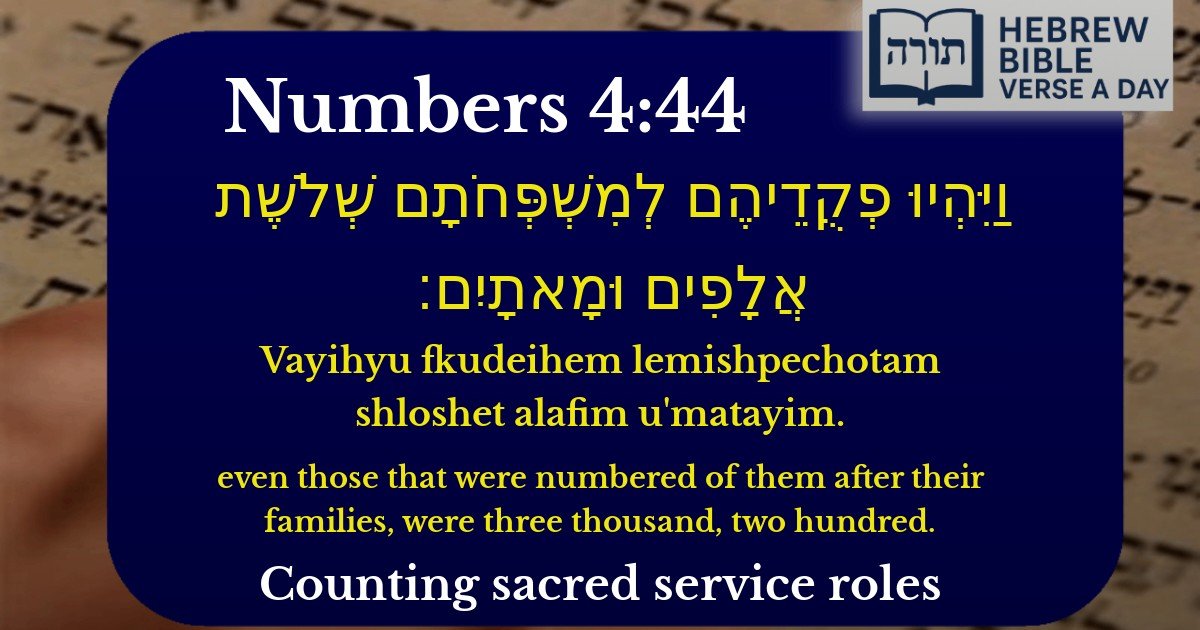
Q: What does Numbers 4:44 mean when it mentions 'those that were numbered after their families'?
A: Numbers 4:44 refers to the census taken of the Levite families from the clan of Merari, who were assigned specific duties in transporting parts of the Mishkan (Tabernacle). The counting was done carefully by families to organize their sacred responsibilities (Rashi on Numbers 4:44).
Q: Why were the Levites counted separately in Numbers 4:44?
A: The Levites were counted separately because they had a unique role in serving the Mishkan (Tabernacle). Unlike other tribes, they were not included in the general census for military purposes but were designated for holy service (Rambam, Hilchot Klei HaMikdash 3:1).
Q: What can we learn from the detailed counting in Numbers 4:44?
A: The detailed counting teaches us the importance of every individual in fulfilling communal responsibilities, especially in sacred work. Each Levite had a specific role, showing that every person's contribution matters (Midrash Tanchuma, Bamidbar 12).
Q: How does the concept of counting by families in Numbers 4:44 apply today?
A: Just as the Levites were counted by families, Judaism emphasizes the value of family lineage and tradition. Many mitzvot (commandments) and roles in Jewish life are connected to one's family heritage, such as Kohanim and Levi'im in synagogue services (Talmud, Kiddushin 76b).
Q: Why does Numbers 4:44 specify the exact number of 3,200 Levites?
A: The Torah gives precise numbers to show the exact fulfillment of Hashem's command and the importance of accountability in sacred tasks. Every individual was necessary for the proper functioning of the Mishkan (Sforno on Numbers 4:44).


Context of the Verse
The verse (Bamidbar 3:22) is part of the census of the tribe of Levi, specifically the Gershonite family, who were assigned duties related to the Mishkan (Tabernacle). The count of 3,200 males from one month old and upward reflects their role in the service of the Mishkan.
Rashi's Commentary
Rashi (Rabbi Shlomo Yitzchaki) explains that the phrase "פְקֻדֵיהֶם לְמִשְׁפְּחֹתָם" ("those that were numbered of them after their families") emphasizes that the counting was conducted according to their familial lineages. This highlights the importance of preserving tribal and familial identities within the broader framework of the Levi'im's sacred duties.
Rambam's Perspective
Rambam (Maimonides), in Hilchot Klei HaMikdash (Laws of the Temple Vessels), discusses the organizational structure of the Levi'im. The precise numbering underscores the meticulousness required in assigning roles for the Mishkan's upkeep, ensuring that each family had clear responsibilities.
Midrashic Insights
Significance of the Number
The figure of 3,200 is not arbitrary. The Baal HaTurim connects it to the Gershonites' spiritual mission: the numerical value of "גרשון" (Gershon) plus the kolel (counting the word itself) equals 320, hinting at their tenfold representation in the census (320 x 10 = 3,200). This reflects their collective strength in serving Hashem.
Practical Implications
The Talmud (Zevachim 17a) derives from this verse that the Levi'im's service was hereditary, passed down through families. The counting reinforced the idea that sacred duties are both a privilege and a responsibility tied to one’s lineage.