Frequently Asked Questions
Q: What does Numbers 5:23 mean in the context of the Sotah ritual?
A: Numbers 5:23 describes part of the Sotah ritual, where a woman suspected of adultery undergoes a test with 'bitter waters.' The Kohen (priest) writes curses (including Hashem's name) on a scroll, then dissolves the ink in the water. According to Rashi, this teaches that if she is innocent, the water will not harm her, but if guilty, it will bring punishment. The blotting out of Hashem's name for peace between husband and wife shows the value of shalom bayit (domestic harmony).
Q: Why does the Torah command blotting out Hashem's name in the Sotah waters?
A: The Talmud (Sotah 20a) explains that Hashem permits His holy name to be erased in this specific case to restore peace between a husband and wife. This demonstrates the great importance Judaism places on maintaining marital harmony (shalom bayit). The Rambam (Hilchos Sotah 3:18) adds that this entire procedure was meant to deter infidelity and uphold the sanctity of marriage.
Q: What practical lesson can we learn from Numbers 5:23 today?
A: Though we no longer perform the Sotah ritual, this verse teaches us: 1) The extreme measures Judaism takes to preserve trust in marriage, 2) That even holy things (like Hashem's written name) may be 'set aside' to achieve greater goods like peace, and 3) That accusations require proper procedure - the husband couldn't simply punish his wife without this elaborate, fair test administered by the Kohen.
Q: How was the Sotah scroll different from regular Torah writing?
A: The Mishnah (Sotah 2:4) specifies that the Kohen wrote these curses on a new parchment scroll using special ink (not iron gall ink used for Torahs, as iron symbolizes harsh judgment). He wrote only the specific verses about the Sotah (Numbers 5:19-22), including Hashem's name, then dissolved it in the water. Rashi notes this showed the words were literally internalized by the woman drinking them.
Q: Why were the waters called 'bitter' in Numbers 5:23?
A: The Midrash (Bamidbar Rabbah 9:15) explains they were called 'bitter' for three reasons: 1) They caused bitter suffering if the woman was guilty, 2) They healed the 'bitterness' of suspicion if she was innocent, and 3) They contained bitter ingredients like wormwood. The Talmud (Sotah 20a) adds that dust from the Mishkan floor was added, connecting the test to the holy sanctuary's purity standards.

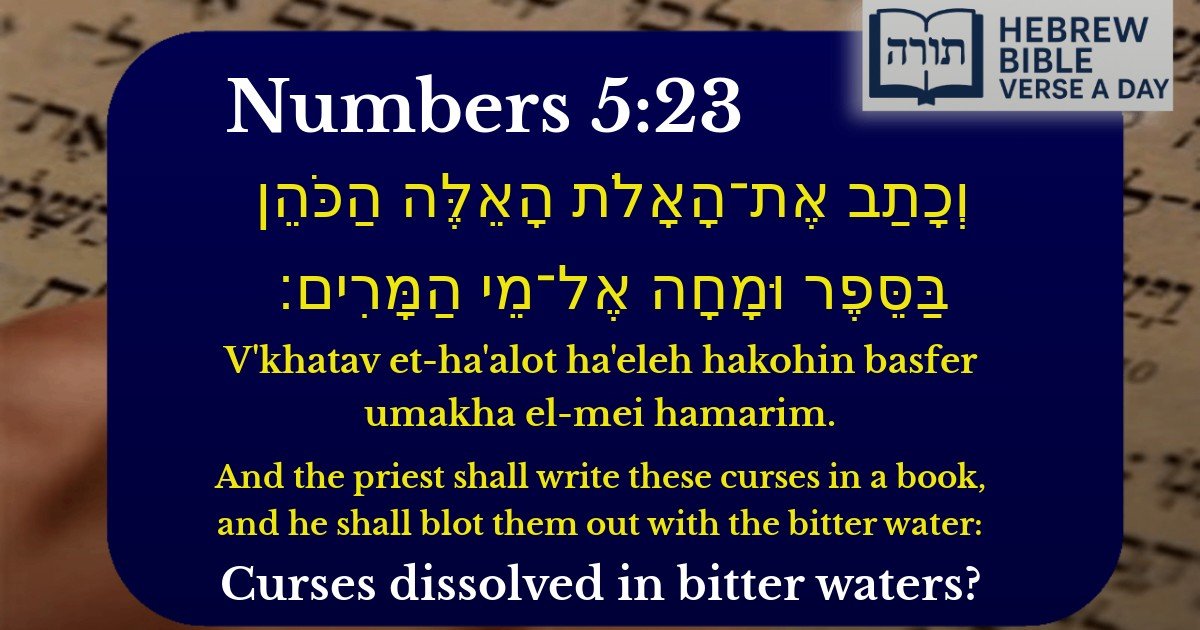

Context in the Torah
The verse (Numbers 5:23) is part of the procedure of the Sotah (a woman suspected of adultery), where the Kohen writes curses on a scroll and dissolves them in the "bitter waters" (mei hame’arim). This is a unique ritual prescribed by the Torah to determine the innocence or guilt of the accused woman.
Rashi's Explanation
Rashi (Rabbi Shlomo Yitzchaki) comments that the Kohen writes the curses "in a book" (ba’sefer)—specifically on a parchment scroll—and then erases them in the water. The curses include the Divine Name (Hashem’s name), which is ordinarily forbidden to erase. However, in this case, the Torah explicitly permits it to bring peace between husband and wife (Shalom Bayit). Rashi emphasizes that this demonstrates the Torah’s deep concern for maintaining marital harmony.
Rambam’s Perspective
In Mishneh Torah (Hilchot Sotah 4:3), the Rambam (Maimonides) explains that the Kohen writes the curses from memory, not by copying from another text, and includes the Divine Name. The erasure of the Name in this specific case is an exception to the general prohibition, as it serves a higher purpose—upholding the sanctity of marriage and deterring infidelity.
Midrashic Insights
Halachic Considerations
The Talmud (Sotah 17b) discusses the exact procedure: the Kohen writes the curses on parchment, then dissolves the ink in the water. The Mishnah (Sotah 2:4) adds that if the woman is innocent, the waters become a blessing, and she is rewarded with children—showing that the process is not merely punitive but also a means of Divine justice and mercy.
Symbolism of the Bitter Waters
The Kli Yakar (Rabbi Shlomo Ephraim Luntschitz) explains that the "bitter waters" represent the bitterness of sin, while the erasure of the curses signifies that repentance can nullify harsh decrees. The ritual thus serves as both a test and a spiritual rectification.