

Join Our Newsletter To Be Informed When New Videos Are Posted
Hebrew Text
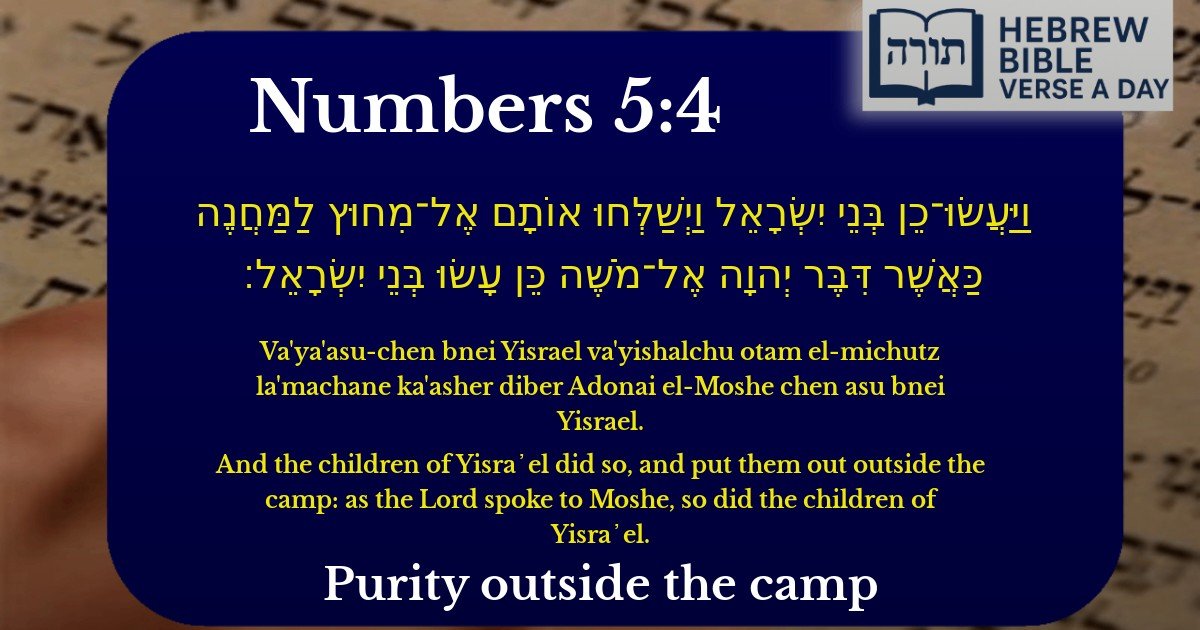
וַיַּעֲשׂוּ־כֵן בְּנֵי יִשְׂרָאֵל וַיְשַׁלְּחוּ אוֹתָם אֶל־מִחוּץ לַמַּחֲנֶה כַּאֲשֶׁר דִּבֶּר יְהוָה אֶל־מֹשֶׁה כֵּן עָשׂוּ בְּנֵי יִשְׂרָאֵל׃
English Translation
And the children of Yisra᾽el did so, and put them out outside the camp: as the Lord spoke to Moshe, so did the children of Yisra᾽el.
Transliteration
Va'ya'asu-chen bnei Yisrael va'yishalchu otam el-michutz la'machane ka'asher diber Adonai el-Moshe chen asu bnei Yisrael.
Hebrew Leining Text
וַיַּֽעֲשׂוּ־כֵן֙ בְּנֵ֣י יִשְׂרָאֵ֔ל וַיְשַׁלְּח֣וּ אוֹתָ֔ם אֶל־מִח֖וּץ לַֽמַּחֲנֶ֑ה כַּאֲשֶׁ֨ר דִּבֶּ֤ר יְהֹוָה֙ אֶל־מֹשֶׁ֔ה כֵּ֥ן עָשׂ֖וּ בְּנֵ֥י יִשְׂרָאֵֽל׃ {פ}
🎵 Listen to leining
Parasha Commentary
📚 Talmud Citations
This verse is not quoted in the Talmud.
Context of the Verse
This verse (Bamidbar 5:4) describes the fulfillment of Hashem's command to Moshe regarding the temporary expulsion of individuals with certain forms of ritual impurity (tum'ah) from the Israelite camp. The Torah emphasizes the obedience of Bnei Yisrael in carrying out this directive precisely as instructed.
Rashi's Explanation
Rashi (Bamidbar 5:4) notes that the double language of "וַיַּעֲשׂוּ־כֵן... כֵּן עָשׂוּ" ("And they did so... so they did") teaches that Bnei Yisrael complied immediately and completely with Hashem's command. This repetition highlights their unwavering commitment to fulfilling the divine will without delay or deviation.
Rambam's Perspective
In Hilchot Tumat Tzara'at (10:6), Rambam explains that this expulsion served both a practical and spiritual purpose: to maintain the sanctity of the camp, which housed the Mishkan (Divine Presence). Those with severe tum'ah were temporarily separated to prevent spiritual contamination of the community.
Midrashic Insights
Halachic Implications
The Sefer HaChinuch (Mitzvah 169) derives from this verse the eternal principle that maintaining communal holiness sometimes requires temporary separation of individuals until their tum'ah is resolved. This concept later informs laws regarding metzora'im (lepers) and other forms of ritual impurity.
Spiritual Message
The Kli Yakar emphasizes that Bnei Yisrael's exact compliance teaches the importance of executing divine commandments with precision. The verse's structure - beginning and ending with their obedience - forms a literary "camp" around the action, mirroring how adherence to mitzvot creates spiritual boundaries.