

Join Our Newsletter To Be Informed When New Videos Are Posted
Hebrew Text
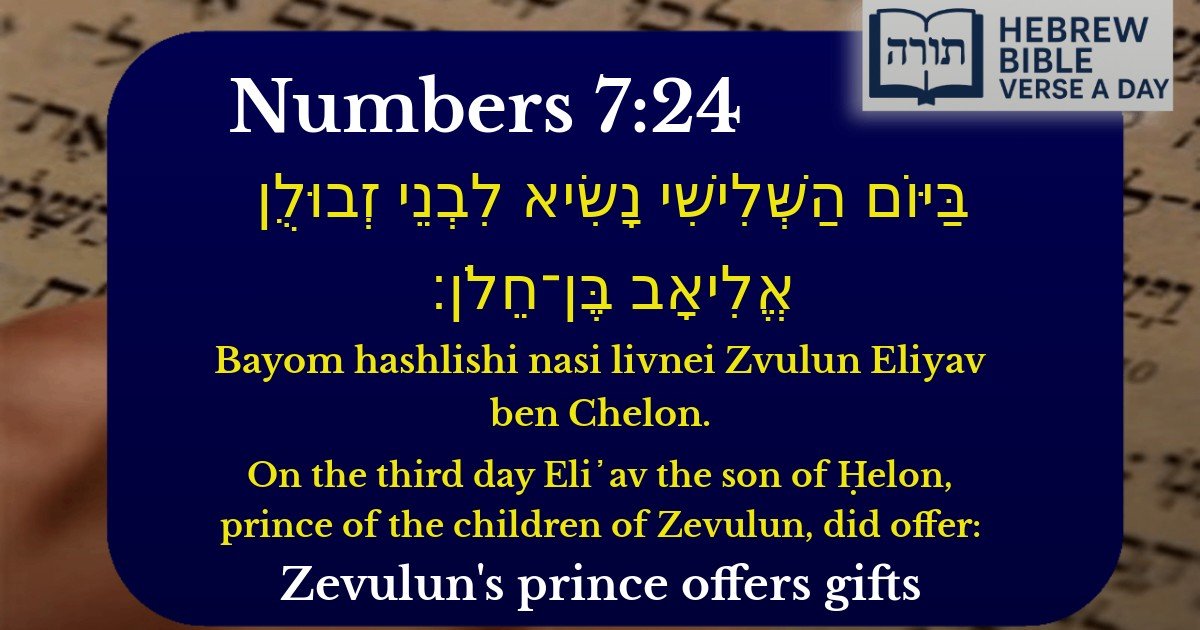
בַּיּוֹם הַשְּׁלִישִׁי נָשִׂיא לִבְנֵי זְבוּלֻן אֱלִיאָב בֶּן־חֵלֹן׃
English Translation
On the third day Eli᾽av the son of Ḥelon, prince of the children of Zevulun, did offer:
Transliteration
Bayom hashlishi nasi livnei Zvulun Eliyav ben Chelon.
Hebrew Leining Text
בַּיּוֹם֙ הַשְּׁלִישִׁ֔י נָשִׂ֖יא לִבְנֵ֣י זְבוּלֻ֑ן אֱלִיאָ֖ב בֶּן־חֵלֹֽן׃
🎵 Listen to leining
Parasha Commentary
📚 Talmud Citations
This verse is not quoted in the Talmud.
Context in the Torah
The verse (Bamidbar 7:24) describes the offerings brought by the nasi (prince) of the tribe of Zevulun, Eli'av ben Chelon, on the third day of the dedication of the Mishkan. This event follows the pattern of each tribal leader presenting identical offerings over twelve consecutive days.
Eli'av ben Chelon: The Prince of Zevulun
Rashi (Bamidbar 7:24) notes that the name "Eli'av" (אֱלִיאָב) means "My God is Father," reflecting his righteousness and connection to the Divine. The Midrash (Bamidbar Rabbah 13:18) highlights that Zevulun's prince was chosen for this honor due to the tribe's role in supporting Torah study through commerce, as Zevulun partnered with Yissachar (Devarim 33:18).
The Significance of the Third Day
The Sforno (Bamidbar 7:24) explains that the sequence of offerings corresponds to the tribes' spiritual stature. Zevulun's offering on the third day may allude to the third day of Creation, when the seas were gathered (Bereishit 1:9-10), symbolizing Zevulun's maritime trade and their role in facilitating Torah study like water sustains life.
Symbolism of the Offerings
Halachic Insights
The Talmud (Chullin 89b) derives from this verse that humility (symbolized by Zevulun's willingness to defer to Yissachar) is greater than sacrifices. Ramban (Bamidbar 7:24) adds that the princes' voluntary offerings set a precedent for nedavot (free-will gifts) to the Mishkan.