Frequently Asked Questions
Q: What does the 'golden spoon of incense' represent in Numbers 7:32?
A: In Numbers 7:32, the golden spoon (כַּף זָהָב) filled with incense (קְטֹרֶת) was part of the offerings brought by the tribal leaders during the dedication of the Mishkan (Tabernacle). According to Rashi, the incense symbolizes prayer and devotion, as the verse in Psalms 141:2 compares prayer to incense. The golden spoon represents the purity and value of the service to Hashem.
Q: Why was the spoon made of gold in this verse?
A: Gold is a precious metal, symbolizing the importance and sanctity of the service in the Mishkan. The Rambam explains that vessels used in divine service were made from the finest materials to honor Hashem. The golden spoon, specifically, reflects the dignity of the ketoret (incense) offering, which had a special significance in the Temple service.
Q: What is the significance of the incense (ketoret) in Jewish tradition?
A: The ketoret (incense) had a unique spiritual role in the Mishkan and later in the Beit HaMikdash (Temple). The Talmud (Keritot 6a) teaches that the ketoret atoned for sins and brought divine favor. It was also a symbol of unity, as it was made from a blend of different spices, representing how Klal Yisrael (the Jewish people) should come together in service to Hashem.
Q: How does the offering of the golden spoon apply to us today?
A: Although we no longer bring physical offerings, the message of the golden spoon and incense remains relevant. The Midrash (Tanchuma, Tetzaveh 14) teaches that our prayers today take the place of the korbanot (offerings). Just as the incense was precious and required proper intent, our tefillot (prayers) should be offered with sincerity and devotion, as if presenting them before Hashem in the Mishkan.
Q: Why was the spoon specifically 'ten shekels' of gold?
A: The weight of ten shekels (עֲשָׂרָה זָהָב) holds symbolic meaning. The number ten represents completeness in Jewish thought, as seen in the Ten Commandments and the Ten Utterances of Creation. Rashi notes that this measurement signifies that the offering was given in full measure, demonstrating the giver's wholehearted dedication to serving Hashem.

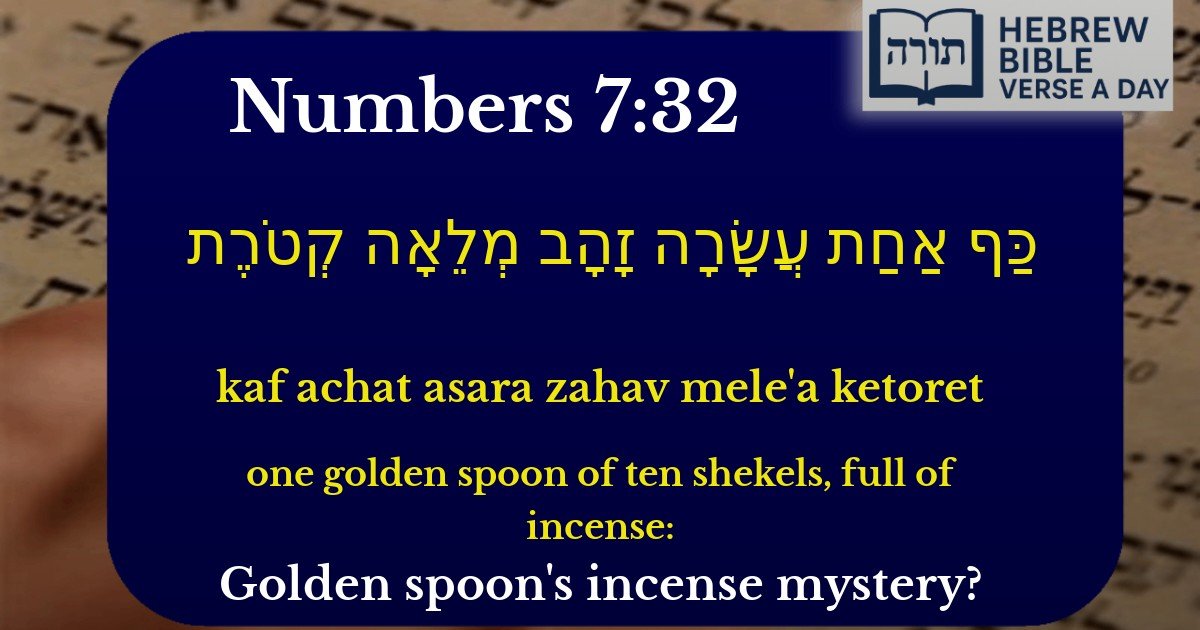

The Golden Spoon (Kaf Achas) in the Temple Service
The verse describes a golden spoon (kaf achas) weighing ten shekels, filled with incense (ketoret), which was used in the Mishkan (Tabernacle) and later in the Beit HaMikdash (Temple). Rashi (Bamidbar 7:14) explains that this spoon was one of the vessels brought as part of the offerings of the tribal leaders during the dedication of the Mishkan.
Symbolism of the Golden Spoon
The Midrash (Bamidbar Rabbah 13:14) teaches that the golden spoon symbolizes the unity of the Jewish people, as it was brought by each tribal leader individually yet identically. The Rambam (Hilchot Klei HaMikdash 2:3) notes that all Temple vessels had to be made with precise measurements, reflecting the sanctity and order of divine service.
The Significance of Ten Shekels
The weight of ten shekels carries deep meaning:
The Incense (Ketoret) and Its Importance
The Ketoret was a sacred blend of spices offered twice daily. The Talmud (Keritot 6a) enumerates its eleven ingredients, while Rashi (Shemot 30:34) emphasizes that its precise composition was a divine commandment. The incense atoned for sins and fostered closeness to Hashem, as stated in the Midrash (Tanchuma, Tetzaveh 15).
Practical Halachic Dimensions
According to the Mishneh Torah (Hilchot Temidin uMusafin 3:1-3), the spoon had to be: