Frequently Asked Questions
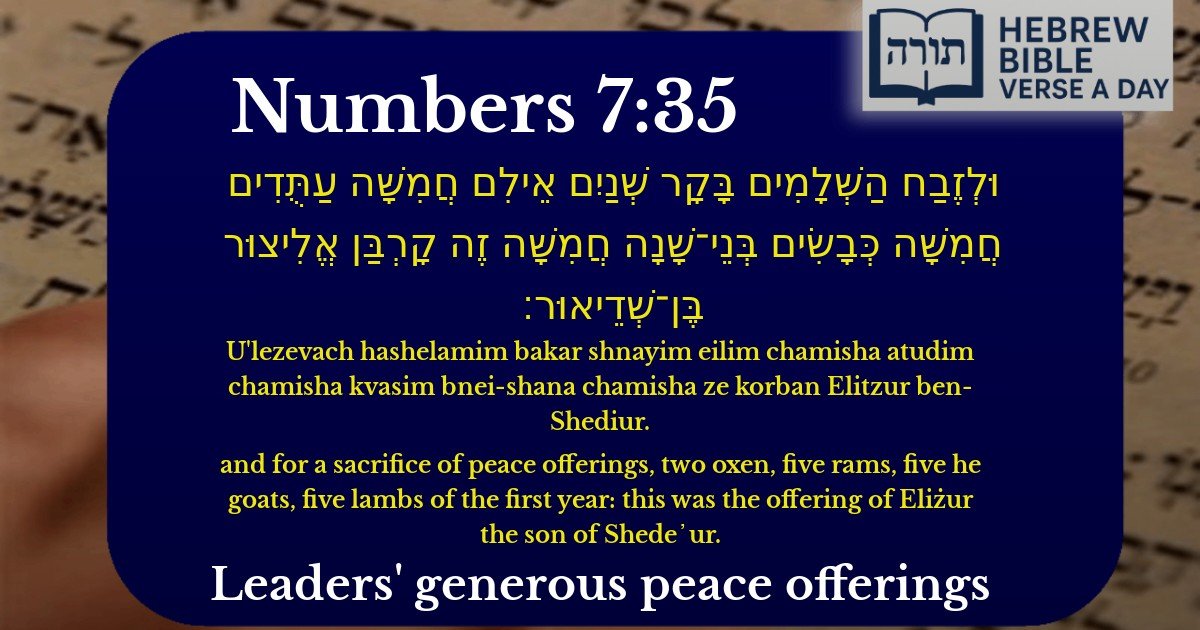
Q: What is the meaning of the peace offering (zevach shelamim) mentioned in Numbers 7:35?
A: The peace offering (zevach shelamim) was a voluntary sacrifice in the Temple expressing gratitude, fulfillment of a vow, or general thanksgiving to Hashem. Unlike other offerings, parts of it were eaten by the person bringing it, their family, and the Kohanim (priests), symbolizing peace and closeness between the person, Hashem, and the community (Rashi on Leviticus 3:1, Rambam Hilchot Korbanot 9:1).
Q: Why did Eliżur bring this specific offering in Numbers 7:35?
A: Eliżur, the prince of the tribe of Reuben, brought this offering as part of the dedication of the Mishkan (Tabernacle). Each tribal leader brought identical offerings to show unity and equal participation in this holy event (Rashi on Numbers 7:10-11, Midrash Bamidbar Rabbah 13:14).
Q: What is the significance of the numbers of animals (2 oxen, 5 rams, etc.) in this verse?
A: The numbers correspond to the standard offering brought by each tribal leader during the Mishkan's dedication. The Torah details each leader's identical offering to emphasize that no tribe was greater than another in this sacred service (Ramban on Numbers 7:17-18). The specific numbers may also hint at deeper meanings, as numbers often carry symbolic significance in Torah (e.g., 5 corresponding to the five books of Torah).
Q: How does the concept of peace offerings apply to us today without the Temple?
A: While we cannot bring physical offerings today, our prayers (tefillot) and acts of kindness (gemilut chasadim) serve as substitutes for sacrifices (Hoshea 14:3, Talmud Berachot 26b). The idea of shelamim teaches us to seek peace with Hashem and others, share our meals with joy and gratitude, and support Torah scholars who represent the Kohanim's role (Aruch HaShulchan OC 248:6).
Q: Why does the Torah repeat nearly identical offerings for each tribal leader?
A: Though the offerings were identical, the Torah lists each leader's contribution separately to honor every tribe and teach that even when people do the same mitzvah, each individual's intention and effort are uniquely precious before Hashem (Midrash Tanchuma Naso 12). This also reflects the idea that all tribes united equally in serving Hashem despite their different roles.


Context of the Verse
The verse (Bamidbar 7:17) describes the korban shelamim (peace offering) brought by Nasi Eliẓur ben Shede’ur, the leader of the tribe of Reuven, during the inauguration of the Mishkan. This offering was part of the twelve-day dedication ceremony, where each tribal leader presented identical offerings on successive days.
Nature of the Shelamim Offering
The shelamim sacrifice is unique in that portions are given to the Mizbe’ach (altar), the Kohanim, and the owner (Vayikra 7:11-21). Rashi (on Vayikra 3:1) explains that the term shelamim derives from shalom (peace), as it brings peace to the world by sustaining the altar, the Kohanim, and the owner. The Rambam (Moreh Nevuchim 3:46) adds that this korban fosters unity and gratitude, as the owner shares it in a festive meal.
Symbolism of the Numbers
Eliẓur ben Shede’ur’s Role
As the first tribal leader to bring his offering after the princes of Yehudah and Yissachar, Eliẓur’s dedication sets a precedent. The Talmud (Sotah 13a) notes that Reuven’s descendants (represented by Eliẓur) demonstrated humility by not demanding precedence despite Reuven being Yaakov’s firstborn. This reflects the principle that true leadership prioritizes harmony over honor.
Spiritual Message
The Ohr HaChaim (Bamidbar 7:17) teaches that the uniformity of the princes’ offerings signifies that all tribes, though distinct, share a common devotion to Hashem. The shelamim, with its emphasis on peace and sharing, underscores the ideal of unity in avodas Hashem.