Frequently Asked Questions
Q: What is the meaning of the peace offering (zevach shelamim) mentioned in Numbers 7:41?
A: The peace offering (zevach shelamim) is a voluntary sacrifice in the Torah that expresses gratitude, fulfills a vow, or is given as a freewill offering. Unlike other sacrifices, parts of it are eaten by the person bringing it, shared with family, and given to the kohanim (priests). Rashi explains that it is called 'shelamim' (from the word 'shalom,' meaning peace) because it brings peace to the world by fostering harmony between people and Hashem.
Q: Why did Shelumiel bring this specific offering with two oxen, five rams, five goats, and five lambs?
A: Shelumiel ben Zurishaddai, the prince of the tribe of Shimon, brought this offering as part of the dedication of the Mishkan (Tabernacle). Each tribal leader brought identical offerings to show unity and equality among the tribes. The Midrash teaches that the numbers and types of animals symbolize different aspects of service to Hashem—strength (oxen), leadership (rams), atonement (goats), and innocence (lambs).
Q: What lesson can we learn from Shelumiel's offering in this verse?
A: Shelumiel's offering teaches the importance of communal unity and personal dedication to serving Hashem. The Talmud (Sotah 37b) highlights that all tribal leaders brought the same offering to emphasize that no tribe was greater than another. Additionally, Rambam (Hilchot Maaseh HaKorbanot) explains that voluntary offerings, like the shelamim, reflect a person's sincere desire to draw closer to Hashem.
Q: Do we still bring peace offerings (shelamim) today?
A: Since the destruction of the Beit HaMikdash (Holy Temple), we no longer bring animal sacrifices, including the shelamim. However, the concept remains relevant through prayer, charity (tzedakah), and acts of kindness, which the Sages say substitute for sacrifices (Talmud Berachot 26a). Many also study the laws of korbanot (sacrifices) in anticipation of the future rebuilding of the Temple.
Q: Why are the animals in this verse specified as 'lambs of the first year'?
A: The Torah often requires young animals (within their first year) for sacrifices because they represent purity and freshness in serving Hashem. Rashi (on Vayikra 9:3) notes that young animals symbolize a person's willingness to offer their best to Hashem. The Talmud (Chullin 22b) also discusses that animals must be free of defects, teaching that our service must be wholehearted and sincere.


Explanation of the Verse
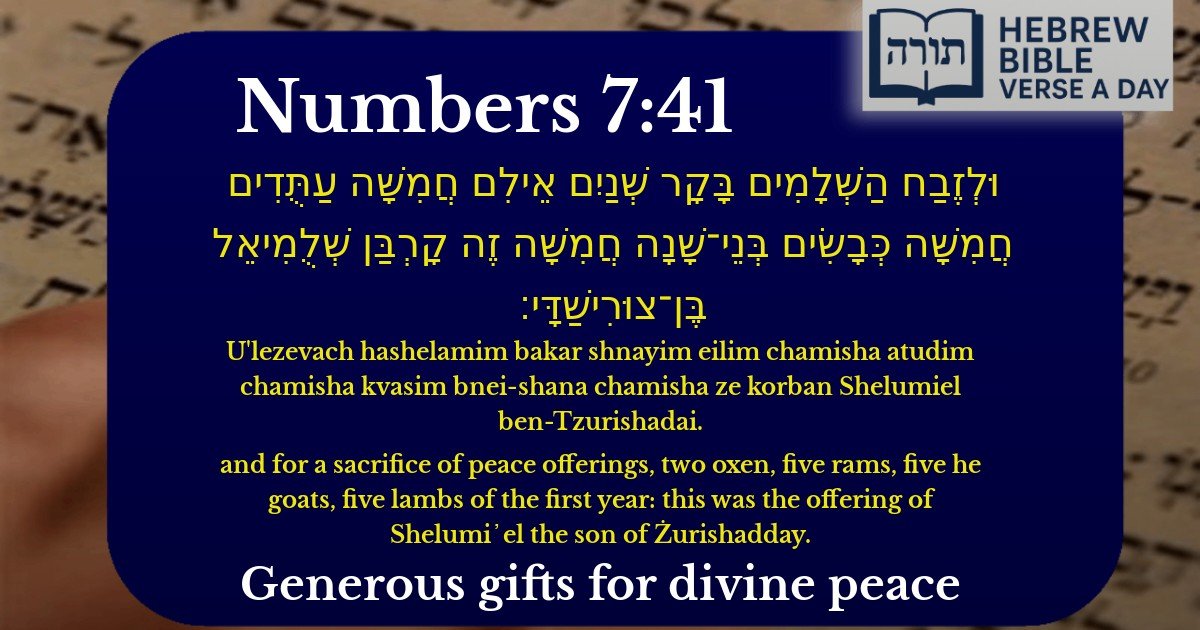
The verse describes the korban shelamim (peace offering) brought by Shelumiel ben Zurishaddai as part of the dedication offerings of the Nesi'im (tribal leaders) for the Mishkan (Tabernacle). The offering consists of two oxen, five rams, five male goats, and five yearling lambs. This follows the pattern of the other tribal leaders' offerings, as detailed in Bamidbar (Numbers) Chapter 7.
Rashi's Commentary
Rashi (Bamidbar 7:47) explains that the korban shelamim was unique in that it was shared between the altar, the Kohanim, and the owner. Part was burned on the altar, part was given to the Kohanim, and the rest was eaten by the one who brought the offering. This symbolizes peace (shalom) and harmony between Hashem, the Kohanim, and the people.
Symbolism of the Numbers
Shelumiel ben Zurishaddai
The name Shelumiel (שְׁלֻמִיאֵל) means "my peace is from G-d," while Zurishaddai (צוּרִישַׁדָּי) means "my Rock is the Almighty." The Midrash (Bamidbar Rabbah 13:19) connects Shelumiel's name to his role in promoting peace among the tribes, particularly during disputes.
The Purpose of the Shelamim Offering
According to the Rambam (Moreh Nevuchim 3:46), the korban shelamim fosters gratitude and closeness to Hashem. The shared meal aspect reinforces communal unity, aligning with Shelumiel's name and legacy of peace.