
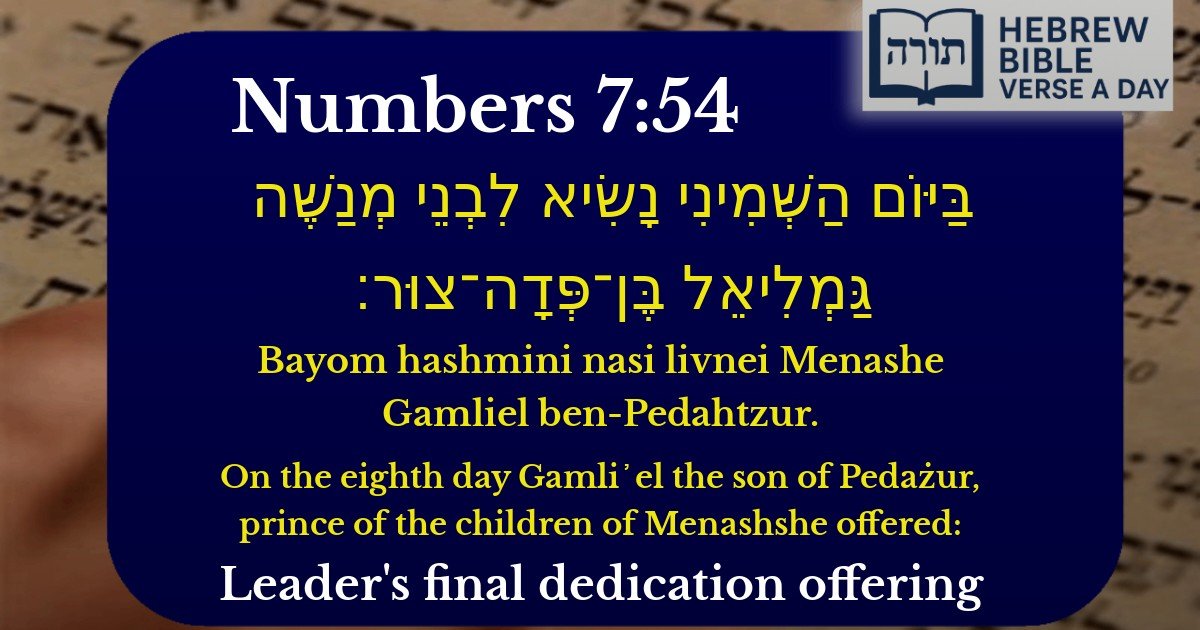

Numbers 7:54 - Leader's final dedication offering

Numbers 7:54 - במדבר 7:54

Hebrew Text

בַּיּוֹם הַשְּׁמִינִי נָשִׂיא לִבְנֵי מְנַשֶּׁה גַּמְלִיאֵל בֶּן־פְּדָה־צוּר׃

English Translation

On the eighth day Gamli᾽el the son of Pedażur, prince of the children of Menashshe offered:

Transliteration

Bayom hashmini nasi livnei Menashe Gamliel ben-Pedahtzur.

Hebrew Leining Text

בַּיּוֹם֙ הַשְּׁמִינִ֔י נָשִׂ֖יא לִבְנֵ֣י מְנַשֶּׁ֑ה גַּמְלִיאֵ֖ל בֶּן־פְּדָהצֽוּר׃

🎵 Listen to leining

Parasha Commentary

Context in the Torah

This verse appears in Bamidbar (Numbers) 7:54, describing the offerings brought by the tribal leaders during the dedication of the Mishkan (Tabernacle). Each day, a different prince (nasi) from one of the twelve tribes brought identical offerings. Gamliel ben Pedahzur represented the tribe of Menashe on the eighth day.

Gamliel ben Pedahzur's Identity

Rashi (Bamidbar 7:54) notes that Gamliel was the son of Pedahzur, who is mentioned earlier in Bamidbar (1:10) as the nasi of Menashe during the wilderness census. The name "Gamliel" (גַּמְלִיאֵל) means "God is my reward," indicating his spiritual stature. The Midrash (Bamidbar Rabbah 14:9) highlights that these leaders were chosen for their righteousness and leadership qualities.

Significance of the Eighth Day

The eighth day holds special meaning in Jewish tradition. The Midrash (Bamidbar Rabbah 14:12) connects it to the dedication of the Mishkan, which began on the first of Nisan (Vayikra 9:1) and lasted seven days, with the eighth day marking the full inauguration. The Talmud (Megillah 10b) also associates the number eight with transcendence beyond nature, symbolizing the divine presence in the Mishkan.

The Tribe of Menashe

  • Order of Offerings: Menashe was the eleventh tribe to bring offerings, following the order of their encampment around the Mishkan (Bamidbar 2:20). The sequence reflects divine wisdom, as noted by Ramban (Bamidbar 7:54).
  • Menashe's Role: As one of Yosef's tribes, Menashe represented resilience and continuity, themes emphasized in Bereshit (Genesis) 48:17-20. The Sforno (Bamidbar 7:54) suggests their offering symbolized unity among the tribes.

Spiritual Lessons

The equal offerings of all twelve princes, despite their different tribal roles, teach the value of unity in avodat Hashem (service of God). The Kli Yakar (Bamidbar 7:54) emphasizes that although each tribe had unique strengths, their shared dedication to the Mishkan demonstrated collective responsibility.

📚 Talmud Citations

This verse is not quoted in the Talmud.

Frequently Asked Questions

Q: Who was Gamliel ben Pedahzur mentioned in Numbers 7:54?
A: Gamliel ben Pedahzur was the prince (nasi) of the tribe of Menashe during the time of the dedication of the Mishkan (Tabernacle). As a leader, he represented his tribe in bringing offerings for the Mishkan's inauguration, as described in this verse and the surrounding passages.
Q: Why is the 'eighth day' significant in Numbers 7:54?
A: The 'eighth day' refers to the final day of the Mishkan's dedication ceremony, when the tribal leaders (nesi'im) brought their offerings. Each day, a different prince brought sacrifices, and Gamliel ben Pedahzur represented Menashe on the eighth day. This sequence teaches the importance of orderly participation and unity among the tribes (Rashi on Numbers 7:54).
Q: What can we learn from Gamliel ben Pedahzur bringing an offering in the Mishkan?
A: Gamliel ben Pedahzur's act teaches the value of leadership and communal responsibility. As a prince, he set an example by contributing to the Mishkan, showing that leaders must actively participate in sacred matters. The Midrash (Bamidbar Rabbah 12:21) highlights how all the leaders demonstrated humility and willingness to serve.
Q: Why does the Torah list each tribe's offering separately if they were identical?
A: Even though each prince brought the same offering, the Torah lists them individually to honor each tribe and its leader. This teaches that every contribution is valued uniquely, and no act of service is merely repetitive (Ramban on Numbers 7:54). Each tribe's dedication was cherished equally before Hashem.