Frequently Asked Questions
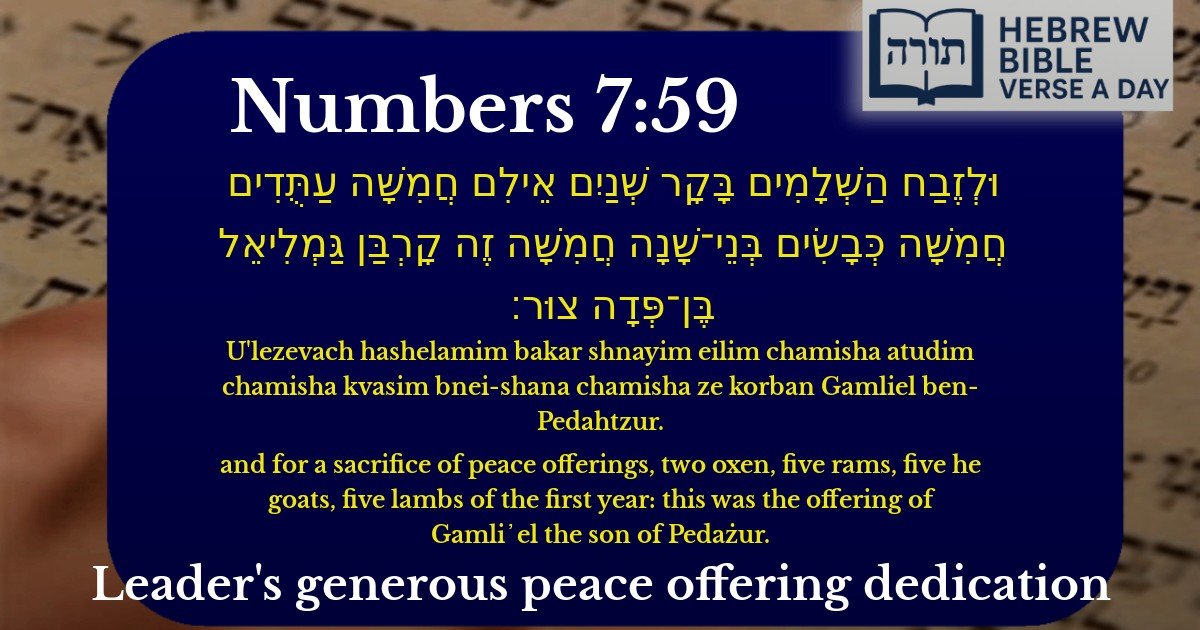
Q: What is the meaning of the 'sacrifice of peace offerings' mentioned in Numbers 7:59?
A: The 'sacrifice of peace offerings' (זֶבַח הַשְּׁלָמִים) refers to a voluntary offering brought to express gratitude, fulfill a vow, or as a freewill gift to Hashem. Unlike other sacrifices, parts of it were eaten by the person bringing it and the kohanim (priests), symbolizing peace and closeness between Hashem and the Jewish people. Rashi explains that these offerings create 'shalom' (peace) in the world.
Q: Why did Gamliel bring this specific offering in Numbers 7:59?
A: Gamliel, the prince of the tribe of Menashe, brought this offering as part of the dedication of the Mishkan (Tabernacle). Each tribal leader brought identical offerings to show unity among the tribes. The Midrash (Bamidbar Rabbah) teaches that despite their individual greatness, all leaders humbly offered the same gifts to emphasize collective devotion to Hashem.
Q: What do the numbers of animals (2 oxen, 5 rams, etc.) symbolize in this verse?
A: The numbers reflect the importance of the Mishkan's dedication. The five animals (rams, goats, lambs) correspond to the five books of the Torah, showing that the Mishkan’s service is rooted in Torah. The two oxen may symbolize the two tablets of the Ten Commandments. The Talmud (Chullin 60b) discusses how numbers in sacrifices often carry deeper spiritual meanings.
Q: How does the concept of 'peace offerings' apply to us today without the Temple?
A: Although we cannot bring sacrifices today, the idea of 'peace offerings' teaches us to seek closeness with Hashem through gratitude, prayer, and acts of kindness. The Rambam (Hilchot Teshuvah) explains that sincere repentance and charity serve as substitutes for sacrifices. Sharing meals with others, especially on Shabbat, also reflects the unity and joy of peace offerings.
Q: Why is Gamliel referred to as 'the son of Pedah-zur' in this verse?
A: The Torah emphasizes lineage to honor both Gamliel and his father, showing that righteousness is a legacy. Rashi notes that Pedah-zur's name means 'the Rock (Hashem) redeemed,' hinting at divine salvation. Naming parents alongside leaders teaches that greatness is built on the foundations of previous generations, as seen in Pirkei Avot (Ethics of the Fathers).


Context of the Verse
This verse appears in Bamidbar (Numbers) 7:42, detailing the offerings brought by Gamliel ben Pedahzur, the prince of the tribe of Menasheh, during the dedication of the Mishkan (Tabernacle). The offerings were part of a twelve-day ceremony in which each tribal leader presented identical sacrifices.
Nature of the Peace Offerings (זֶבַח הַשְּׁלָמִים)
Rashi explains that the zevach shelamim (peace offering) symbolizes harmony and gratitude between Hashem, the Kohanim, and the one bringing the offering. Unlike other sacrifices, portions of the shelamim were eaten by the owner, the Kohanim, and burned on the altar, fostering unity (Rashi on Vayikra 3:1).
Significance of the Numbers
Gamliel ben Pedahzur's Role
The Sforno notes that Gamliel, as the leader of Menasheh, embodied the tribe's dedication to unity and service. His name, meaning "G-d is my reward," reflects his righteousness in faithfully representing his tribe in bringing the offerings.
Symbolism of the Offerings
The Kli Yakar explains that the variety of animals—oxen, rams, goats, and lambs—represents different aspects of divine service: strength (oxen), devotion (rams), atonement (goats), and innocence (lambs). Together, they signify a complete dedication to Hashem.