Frequently Asked Questions
Q: What is the significance of the tribal leaders bringing offerings in Numbers 7?
A: In Numbers 7, each of the 12 tribal leaders (nasi) brought identical offerings for the dedication of the Mishkan (Tabernacle). The Torah repeats the details of each offering to show that although they brought the same gifts, each leader's contribution was equally valued and unique in Hashem's eyes (Rashi on Numbers 7:11). This teaches us that sincere service to Hashem is cherished regardless of outward appearances.
Q: Why does the Torah list each tribal prince's offering separately if they were all the same?
A: Even though all 12 princes brought identical offerings, the Torah lists each one individually to honor each tribe and its leader (Midrash Tanchuma, Naso 14). This teaches that in serving Hashem, every individual and community's contribution matters, even if it seems similar to others. Each tribe had its own unique intentions and spiritual approach (Ramban on Numbers 7:11).
Q: Who was Achira ben Enan, the prince of Naftali mentioned in Numbers 7:78?
A: Achira ben Enan was the tribal leader (nasi) of Naftali during the wilderness journey. The Midrash (Bamidbar Rabbah 13:17) notes that his name 'Achira' (אחירע) can hint to his righteous qualities - 'ach' (brotherly) and 'ra' (good), showing he was a kind and virtuous leader. As the last prince to bring his offering on the 12th day, he demonstrated patience and enthusiasm in serving Hashem.
Q: What practical lesson can we learn from the order of the tribal offerings in Numbers 7?
A: The order of the offerings follows the arrangement of the tribes around the Mishkan (Rashi on Numbers 7:12). This teaches that proper structure and order are important in divine service. Additionally, since the last tribe (Naftali) brought its offering with the same joy as the first, we learn to serve Hashem with consistent enthusiasm, whether we are 'first' or 'last' in any mitzvah opportunity (Talmud, Arachin 16b).


Context of the Verse
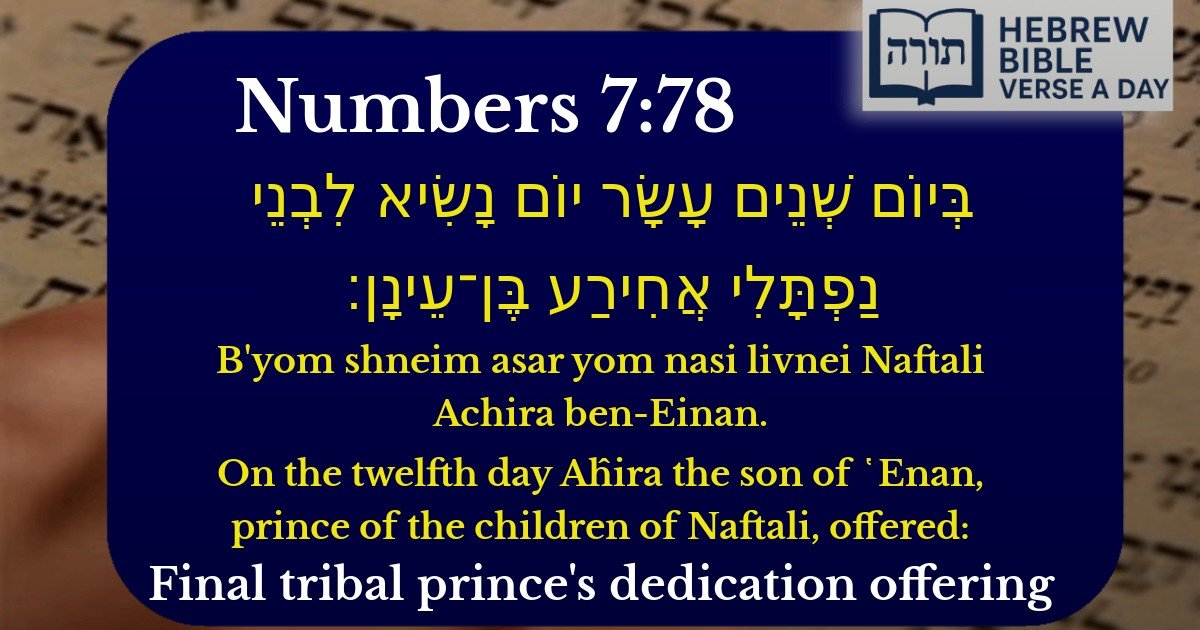
This verse (Bamidbar 7:78) describes the offering brought by Aĥira ben ῾Enan, the prince of the tribe of Naftali, on the twelfth day of the dedication of the Mishkan (Tabernacle). Each tribal leader (nasi) brought identical offerings over twelve consecutive days, as detailed in Parashat Naso.
The Significance of the Order
Rashi (Bamidbar 7:78) notes that the sequence of the tribal offerings followed the order of their encampment around the Mishkan, as described in Bamidbar 2. Naftali was part of the camp of Dan, which traveled last, hence their prince's offering was brought on the twelfth day. This teaches that every tribe had its designated role and honor in the service of Hashem.
The Meaning of Aĥira's Name
The Midrash (Bamidbar Rabbah 14:11) comments on the name Aĥira ben ῾Enan:
The Tribe of Naftali's Unique Role
Ramban (Bamidbar 7:78) explains that Naftali's offering, though last, was no less significant. The tribe was known for its swiftness (as per Bereshit 49:21, "Naftali is a deer let loose"), symbolizing agility in performing mitzvot. Their delayed offering highlights that enthusiasm in divine service is not about timing but sincerity.
Symbolism in the Offerings
The Sforno (Bamidbar 7:78) emphasizes that all twelve tribes brought identical offerings to demonstrate unity. Despite their different roles and strengths, their equal participation in the Mishkan's dedication reflected the principle of Kol Yisrael areivim zeh lazeh (all Jews are responsible for one another).