
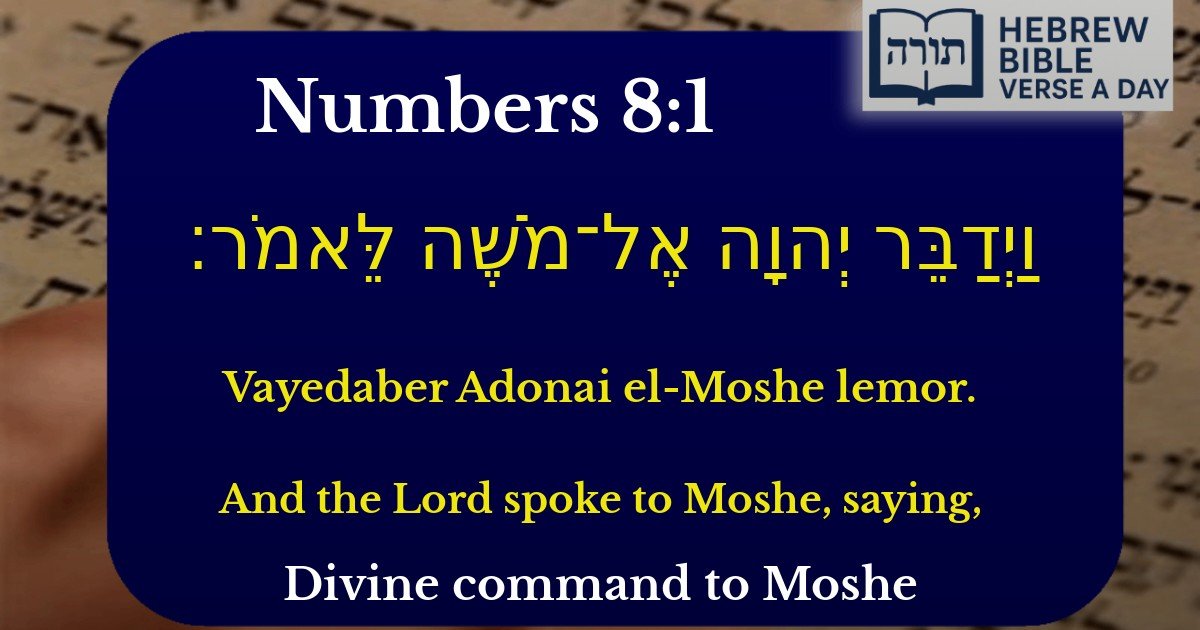

Numbers 8:1 - Divine command to Moshe

Numbers 8:1 - במדבר 8:1

Hebrew Text

וַיְדַבֵּר יְהוָה אֶל־מֹשֶׁה לֵּאמֹר׃

English Translation

And the Lord spoke to Moshe, saying,

Transliteration

Vayedaber Adonai el-Moshe lemor.

Hebrew Leining Text

וַיְדַבֵּ֥ר יְהֹוָ֖ה אֶל־מֹשֶׁ֥ה לֵּאמֹֽר׃

🎵 Listen to leining

Parasha Commentary

The Divine Communication to Moshe

The phrase "וַיְדַבֵּר יְהוָה אֶל־מֹשֶׁה לֵּאמֹר" ("And the Lord spoke to Moshe, saying") appears frequently in the Torah, particularly in the books of Shemot, Vayikra, and Bamidbar. This formulation signifies the transmission of divine commandments and teachings directly from Hashem to Moshe Rabbeinu.

Rashi's Explanation

Rashi (Shemot 6:2) notes that this expression emphasizes the clarity and directness of Hashem's communication with Moshe. Unlike other prophets who received messages through visions or allegories, Moshe heard Hashem's words "face to face" (Bamidbar 12:8), with unparalleled clarity.

Rambam's Perspective

In Moreh Nevuchim (Guide for the Perplexed 2:34), the Rambam explains that Moshe's prophecy was unique in that it occurred while he was fully awake and cognizant, without the need for dreams or parables. This underscores the singular nature of Moshe's prophecy, which forms the foundation of Torah she'Bichtav (Written Torah).

Talmudic Insights

  • The Talmud (Yevamot 49b) teaches that all other prophets received their messages through an angelic intermediary, whereas Moshe heard directly from Hashem ("פה אל פה אדבר בו" - "mouth to mouth I speak with him").
  • In Megillah 31b, Chazal derive from this phrase that Moshe would repeat Hashem's words verbatim to Bnei Yisrael, ensuring precise transmission of the divine commandments.

Midrashic Interpretations

The Midrash (Shemot Rabbah 28:6) comments that this introductory phrase appears precisely 70 times in the Torah, corresponding to the 70 elders who would later assist Moshe in leading the nation. This teaches that authentic Torah leadership must be rooted in direct divine communication.

Kabbalistic Dimension

The Zohar (Vayikra 7a) explains that the word "לֵּאמֹר" ("saying") indicates that Moshe was to transmit these words to future generations, emphasizing the eternal nature of Torah she'Bichtav and its relevance for all times.

📚 Talmud Citations

This verse is not quoted in the Talmud.

Frequently Asked Questions

Q: What does it mean when the verse says 'And the Lord spoke to Moshe, saying'?
A: This phrase appears frequently in the Torah to introduce direct communication from Hashem to Moshe. Rashi explains that this wording emphasizes that Moshe transmitted G-d's words exactly as he received them, without adding or omitting anything. It shows Moshe's role as the faithful transmitter of Torah.
Q: Why does the Torah keep repeating 'And the Lord spoke to Moshe'?
A: The repetition teaches us that every word of Torah comes directly from Hashem. The Rambam (Maimonides) explains in his principles of faith that the entire Torah was given to Moshe from Heaven. Each repetition reinforces that these aren't Moshe's own ideas, but divine commandments.
Q: What can we learn from how G-d spoke to Moshe?
A: The Talmud (Yevamot 49b) teaches that Moshe was unique in receiving prophecy 'face to face' with total clarity. This teaches us about the special level of Moshe's prophecy and the directness of Torah transmission. It also shows the importance of clear communication when teaching Torah to others.
Q: Why does it say 'saying' after 'spoke'? Isn't that redundant?
A: The Midrash (Sifrei) explains that 'saying' implies Moshe was commanded to repeat these words to the Jewish people. The extra word teaches that leaders must clearly transmit Torah teachings to the community. Rashi notes this pattern shows Moshe's role in conveying G-d's words to Israel.
Q: How does this verse apply to us today?
A: This verse reminds us that Torah comes directly from Hashem. The Rambam writes that this belief is fundamental to Judaism. It teaches us to approach Torah study with reverence, knowing we're learning divine wisdom. Just as Moshe transmitted faithfully, we must be careful to preserve authentic Torah tradition.