Frequently Asked Questions
Q: What does Numbers 8:7 mean in the context of the Torah?
A: Numbers 8:7 describes the purification process for the Levites before they began their service in the Mishkan (Tabernacle). According to Rashi, this verse teaches that the Levites needed spiritual cleansing through sprinkling 'mei chatat' (water mixed with ashes of the red heifer), shaving their entire body, and washing their clothes to attain ritual purity for their sacred duties.
Q: Why did the Levites need to shave all their hair for purification?
A: The Rambam (Hilchot Bi'at HaMikdash 1:13) explains that shaving all bodily hair symbolized a complete renewal and detachment from impurity, similar to a metzora (person afflicted with tzara'at) who shaves upon purification. The Talmud (Nazir 39b) also connects this to demonstrating total dedication to divine service, leaving no 'barrier' between themselves and holiness.
Q: What is the significance of the 'water of purifying' mentioned in this verse?
A: The 'mei chatat' (water of purifying) refers to water mixed with ashes of the parah adumah (red heifer), as explained in Numbers 19. The Midrash (Bamidbar Rabbah 8:5) emphasizes that this unique purification process elevated the Levites to a higher spiritual state, enabling them to serve in the Mishkan. Only this mixture could remove certain types of ritual impurity.
Q: How does the purification process in Numbers 8:7 apply to Jews today?
A: While the Temple service is currently suspended, the principles remain relevant: 1) The Mishnah (Yoma 2a) derives from this verse that physical cleanliness accompanies spiritual preparation. 2) The Rambam (Hilchot Klei HaMikdash 3:8) notes that contemporary Torah scholars—compared to the Levites—should approach Torah study with similar purity of intention. 3) Many have the custom to cut hair before Shavuot, recalling the Levites' dedication.
Q: Why did the Levites wash their clothes during purification?
A: Rashi (on this verse) explains that clothing can absorb impurity, requiring washing as part of the taharah (purification) process. The Talmud (Zevachim 19b) further teaches that just as the garments of the Kohen Gadol on Yom Kippur had to be perfectly clean, the Levites' mundane clothing also needed purification to reflect their new sanctified status as servants in the Mishkan.

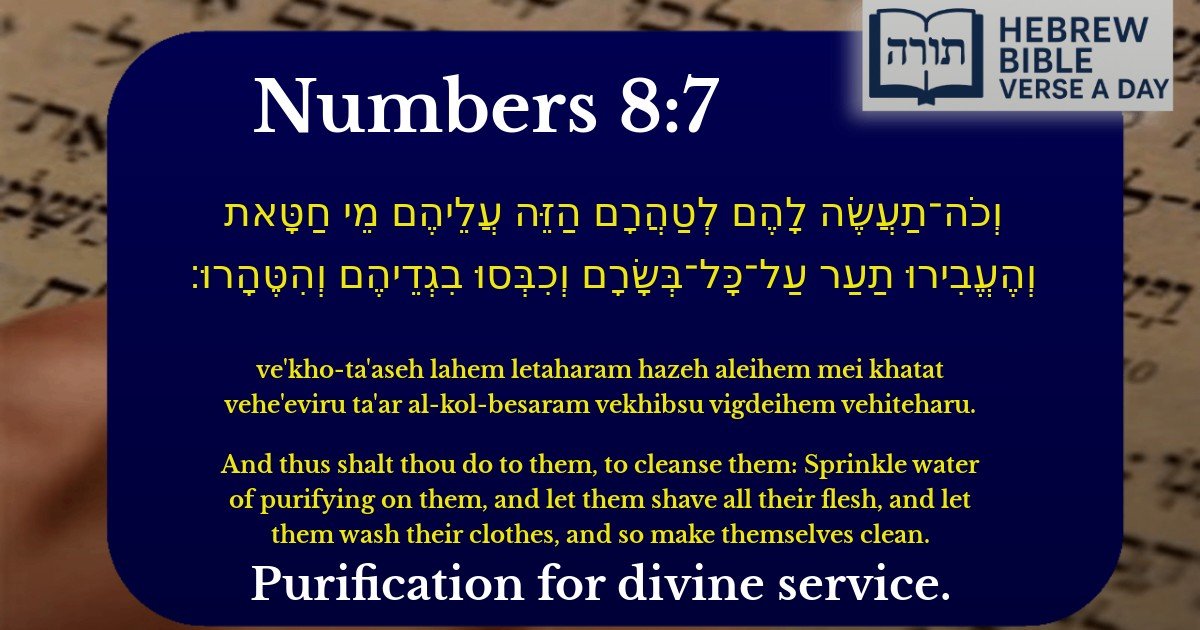

Context of the Verse
This verse (Bamidbar 8:7) describes the purification process for the Levi'im (Levites) as they were consecrated for service in the Mishkan (Tabernacle). The Torah outlines specific steps to prepare them for their sacred duties, emphasizing physical and spiritual purification.
Explanation of the Purification Process
Spiritual Significance
The Sforno emphasizes that these steps were not merely physical but represented deeper spiritual preparation. The Levi'im needed to purify themselves entirely—body, clothing, and soul—before assuming their holy service. The process mirrors the broader Jewish ideal of teshuvah (repentance) and dedication to divine service.
Connection to the Levi'im's Role
Rabbi Samson Raphael Hirsch explains that the Levi'im were set apart to assist the Kohanim and serve as spiritual role models. Their purification process underscored the seriousness of their mission, teaching that those who serve Hashem must strive for the highest levels of purity and devotion.