

Join Our Newsletter To Be Informed When New Videos Are Posted
Hebrew Text
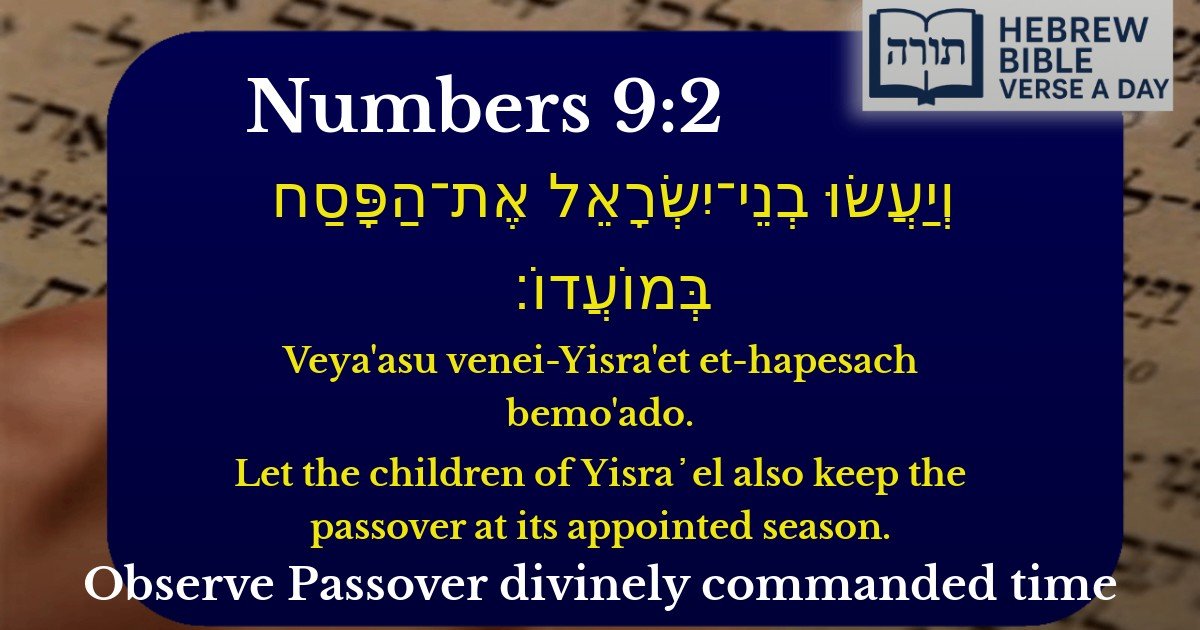
וְיַעֲשׂוּ בְנֵי־יִשְׂרָאֵל אֶת־הַפָּסַח בְּמוֹעֲדוֹ׃
English Translation
Let the children of Yisra᾽el also keep the passover at its appointed season.
Transliteration
Veya'asu venei-Yisra'et et-hapesach bemo'ado.
Hebrew Leining Text
וְיַעֲשׂ֧וּ בְנֵי־יִשְׂרָאֵ֛ל אֶת־הַפָּ֖סַח בְּמוֹעֲדֽוֹ׃
🎵 Listen to leining
Parasha Commentary
📚 Talmud Citations
This verse is quoted in the Talmud.
📖 Pesachim 66a
The verse is referenced in a discussion about the proper time for observing Passover and the obligations of the Israelites regarding its observance.
📖 Rosh Hashanah 5a
The verse is cited in a broader discussion about appointed times (mo'adim) and the importance of observing commandments at their designated times.
Overview of the Verse
The verse "וְיַעֲשׂוּ בְנֵי־יִשְׂרָאֵל אֶת־הַפָּסַח בְּמוֹעֲדוֹ" (Bamidbar 9:2) commands Bnei Yisrael to observe the Korban Pesach (Paschal sacrifice) at its designated time. This mitzvah is foundational in Jewish tradition, as it commemorates Yetziat Mitzrayim (the Exodus from Egypt) and reaffirms our covenant with Hashem.
Rashi's Explanation
Rashi (Bamidbar 9:2) emphasizes the importance of performing the Korban Pesach precisely at its appointed time ("בְּמוֹעֲדוֹ"). He notes that this mitzvah was given in the second year after the Exodus, reinforcing that it is an enduring obligation for future generations. Rashi also connects this verse to the concept of Pesach Sheni (the "Second Passover" in Bamidbar 9:6-13), which provides an opportunity for those who were ritually impure or distant to observe the mitzvah a month later.
Rambam's Perspective
In Hilchot Korban Pesach (1:1), the Rambam (Maimonides) elaborates on the obligation, stating that the Korban Pesach must be brought on the 14th of Nisan, as derived from this verse. He underscores that this mitzvah applies even when the Beit HaMikdash is not standing (in potential), highlighting its eternal significance in Jewish law.
Midrashic Insights
The Midrash (Sifrei Bamidbar 67) interprets the phrase "בְּמוֹעֲדוֹ" as teaching that the Korban Pesach overrides Shabbat when its date coincides with Shabbat. This demonstrates the supreme importance of fulfilling this mitzvah at its exact time, even if it requires performing actions (such as slaughtering and roasting the lamb) that would otherwise be prohibited on Shabbat.
Key Halachic Principles
Spiritual Significance
The Sefer HaChinuch (Mitzvah 380) explains that the Korban Pesach serves as a perpetual reminder of Hashem’s miracles in Egypt and our transition from slavery to freedom. By observing it "בְּמוֹעֲדוֹ," we reaffirm our commitment to Divine service and our identity as the nation chosen to receive the Torah.