
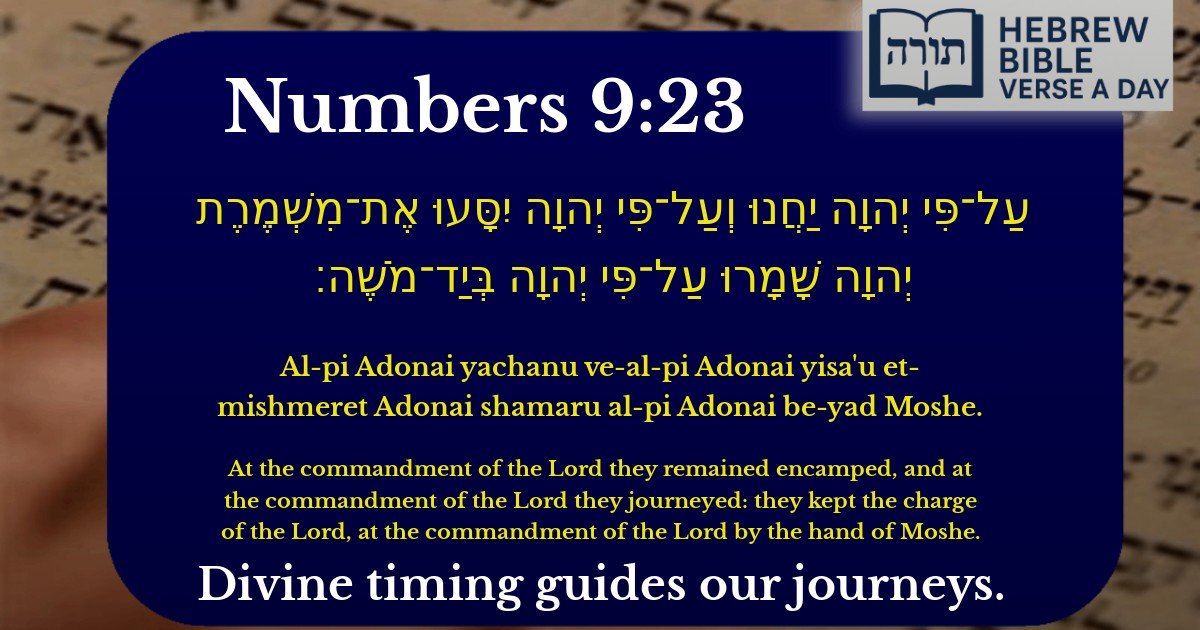

Numbers 9:23 - Divine timing guides our journeys.

Numbers 9:23 - במדבר 9:23

Hebrew Text

עַל־פִּי יְהוָה יַחֲנוּ וְעַל־פִּי יְהוָה יִסָּעוּ אֶת־מִשְׁמֶרֶת יְהוָה שָׁמָרוּ עַל־פִּי יְהוָה בְּיַד־מֹשֶׁה׃

English Translation

At the commandment of the Lord they remained encamped, and at the commandment of the Lord they journeyed: they kept the charge of the Lord, at the commandment of the Lord by the hand of Moshe.

Transliteration

Al-pi Adonai yachanu ve-al-pi Adonai yisa'u et-mishmeret Adonai shamaru al-pi Adonai be-yad Moshe.

Hebrew Leining Text

עַל־פִּ֤י יְהֹוָה֙ יַחֲנ֔וּ וְעַל־פִּ֥י יְהֹוָ֖ה יִסָּ֑עוּ אֶת־מִשְׁמֶ֤רֶת יְהֹוָה֙ שָׁמָ֔רוּ עַל־פִּ֥י יְהֹוָ֖ה בְּיַד־מֹשֶֽׁה׃ {פ}

🎵 Listen to leining

Parasha Commentary

Understanding the Verse in Context

The verse (Bamidbar 9:23) describes the Israelites' encampment and journeys in the wilderness, emphasizing their complete obedience to Hashem's command through Moshe. This reflects the divine guidance that governed every aspect of their travels.

Rashi's Explanation

Rashi explains that the phrase "עַל־פִּי יְהוָה" ("at the commandment of the Lord") underscores that the Israelites did not move or stay based on human reasoning but strictly followed Hashem's will as communicated through Moshe. The repetition of this phrase highlights their unwavering commitment to divine instruction.

Rambam's Perspective

Rambam (Hilchot Yesodei HaTorah 8:1) teaches that the divine command was transmitted via the Ananei HaKavod (Clouds of Glory), which signaled when to journey or encamp. This miraculous phenomenon demonstrated Hashem's direct involvement in guiding Bnei Yisrael.

Midrashic Insights

  • The Midrash Tanchuma (Bamidbar 12) notes that the Israelites' obedience was so complete that even if the cloud lifted at an inconvenient time (e.g., midnight), they would immediately prepare to journey.
  • The Sifrei emphasizes that their adherence to Hashem's command was a merit that sustained them in the wilderness.

The Role of Moshe

The phrase "בְּיַד־מֹשֶׁה" ("by the hand of Moshe") teaches that Moshe was the sole conduit for Hashem's instructions. This reinforces the principle of Torah MiSinai—that Moshe's authority was divinely ordained and unchallengeable (see Rambam's 8th Principle of Faith).

Practical Lessons

  • The verse models bitachon (trust in Hashem), as the Israelites relied entirely on divine timing.
  • It also teaches the importance of shmirat mitzvot (guarding commandments) with precision, as reflected in the phrase "אֶת־מִשְׁמֶרֶת יְהוָה שָׁמָרוּ" ("they kept the charge of the Lord").

📚 Talmud Citations

This verse is quoted in the Talmud.

📖 Yoma 75b
The verse is cited in a discussion about the divine guidance of the Israelites in the wilderness, emphasizing their obedience to God's commandments through Moses.
📖 Sotah 37a
Referenced in the context of the Israelites' encampment and journeying according to God's will, illustrating their adherence to divine instruction.

Frequently Asked Questions

Q: What does Numbers 9:23 mean?
A: Numbers 9:23 describes how the Israelites in the wilderness followed Hashem's commands precisely—when to camp and when to travel—through Moshe's guidance. Rashi explains that this shows their complete obedience to Hashem's will, even when it meant frequently moving or staying put without a fixed schedule.
Q: Why is this verse important?
A: This verse highlights the ideal relationship between the Jewish people and Hashem: total trust and submission to His directives. The Midrash (Bamidbar Rabbah) notes that this unwavering commitment became a model for future generations in serving Hashem with devotion, regardless of personal convenience.
Q: How does this apply to us today?
A: Just as the Israelites followed Hashem's commands through Moshe, we follow the Torah's mitzvot as transmitted by our sages. The Rambam (Hilchot Yesodei HaTorah) teaches that accepting divine authority—even when we don't understand the reasons—strengthens our spiritual connection and aligns us with Hashem's will.
Q: What does 'they kept the charge of the Lord' mean?
A: The phrase refers to the Israelites' meticulous observance of Hashem's instructions. The Talmud (Yoma 28b) connects this to the concept of 'shomrei mitzvot'—guardians of commandments—emphasizing that every generation must preserve Torah traditions with the same vigilance as the wilderness generation did.
Q: Why does the verse mention Moshe's role?
A: Moshe was the conduit for Hashem's commands, as the Torah was given through him. The Sifrei (Bamidbar) explains that this teaches us the importance of Torah leadership—just as the Israelites relied on Moshe for divine guidance, we rely on authentic Torah scholars to interpret Hashem's will for our times.