

Join Our Newsletter To Be Informed When New Videos Are Posted
Hebrew Text
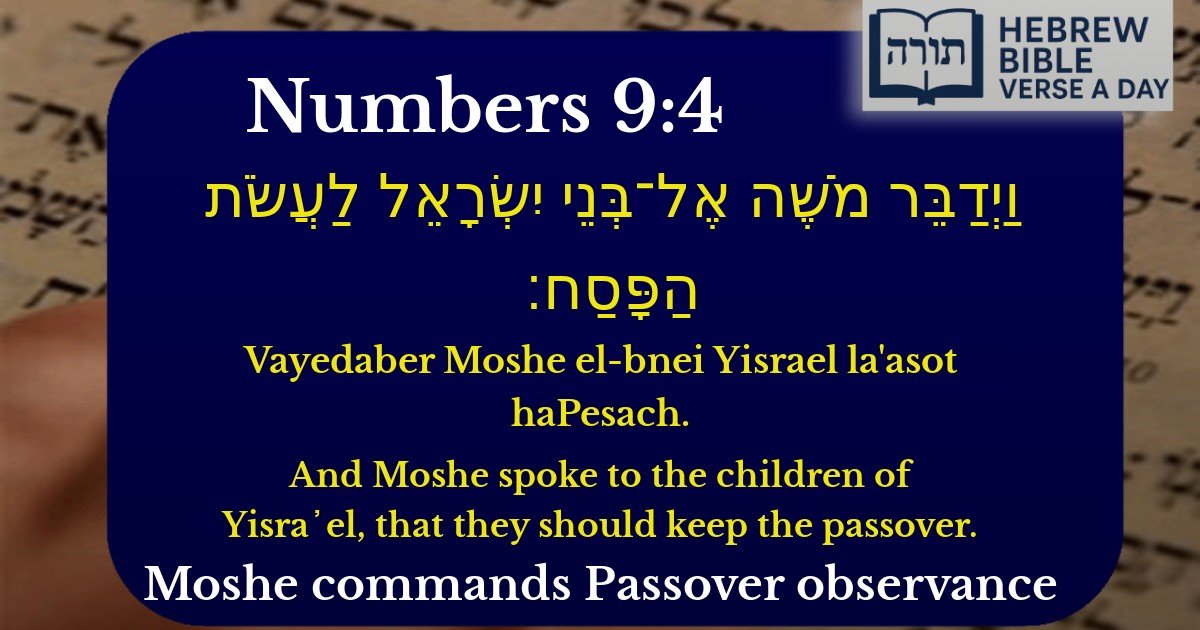
וַיְדַבֵּר מֹשֶׁה אֶל־בְּנֵי יִשְׂרָאֵל לַעֲשֹׂת הַפָּסַח׃
English Translation
And Moshe spoke to the children of Yisra᾽el, that they should keep the passover.
Transliteration
Vayedaber Moshe el-bnei Yisrael la'asot haPesach.
Hebrew Leining Text
וַיְדַבֵּ֥ר מֹשֶׁ֛ה אֶל־בְּנֵ֥י יִשְׂרָאֵ֖ל לַעֲשֹׂ֥ת הַפָּֽסַח׃
🎵 Listen to leining
Parasha Commentary
📚 Talmud Citations
This verse is quoted in the Talmud.
📖 Pesachim 96a
The verse is referenced in the discussion about the commandment to keep the Passover and the role of Moses in conveying this commandment to the Israelites.
Context of the Verse
The verse (Shemot 12:21) occurs during the narrative of the Exodus, where Moshe instructs Bnei Yisrael regarding the Korban Pesach (Paschal sacrifice) before their departure from Mitzrayim. This commandment is central to the redemption from slavery and the establishment of Bnei Yisrael as a nation.
Rashi's Explanation
Rashi (Rabbi Shlomo Yitzchaki) comments that Moshe's instruction here is a reiteration of the earlier command (given in Shemot 12:3-11), emphasizing the urgency and importance of fulfilling the mitzvah precisely as commanded. Rashi notes that the phrase "לַעֲשֹׂת הַפֶּסַח" ("to keep the Passover") refers not only to the sacrifice itself but also to all its accompanying mitzvot, such as eating matzah and maror, and telling the story of Yetziat Mitzrayim (the Exodus).
Rambam's Perspective
In Mishneh Torah (Hilchot Korban Pesach 1:1), the Rambam (Rabbi Moshe ben Maimon) elaborates that the Korban Pesach is a unique mitzvah, as it was the first commandment given collectively to Bnei Yisrael. Its performance demonstrated their faith in Hashem and their readiness to follow His commandments, marking their transition from slaves to servants of the Almighty.
Midrashic Insights
The Mechilta (a halachic Midrash on Shemot) explains that Moshe's instruction was given with great clarity and detail to ensure that every family understood how to properly observe the mitzvah. The Midrash emphasizes that the blood of the Korban Pesach on the doorposts was a public declaration of faith, distinguishing Bnei Yisrael from the Egyptians.
Key Themes in the Verse
Halachic Implications
The Gemara (Pesachim 96a) discusses the details of how the Korban Pesach was to be prepared and eaten, including the requirement to roast it whole and consume it in groups. These halachot underscore the precision required in fulfilling mitzvot and the importance of remembering Yetziat Mitzrayim in every generation.